Astronauts Set for Final Space Station Solar Array Spacewalk
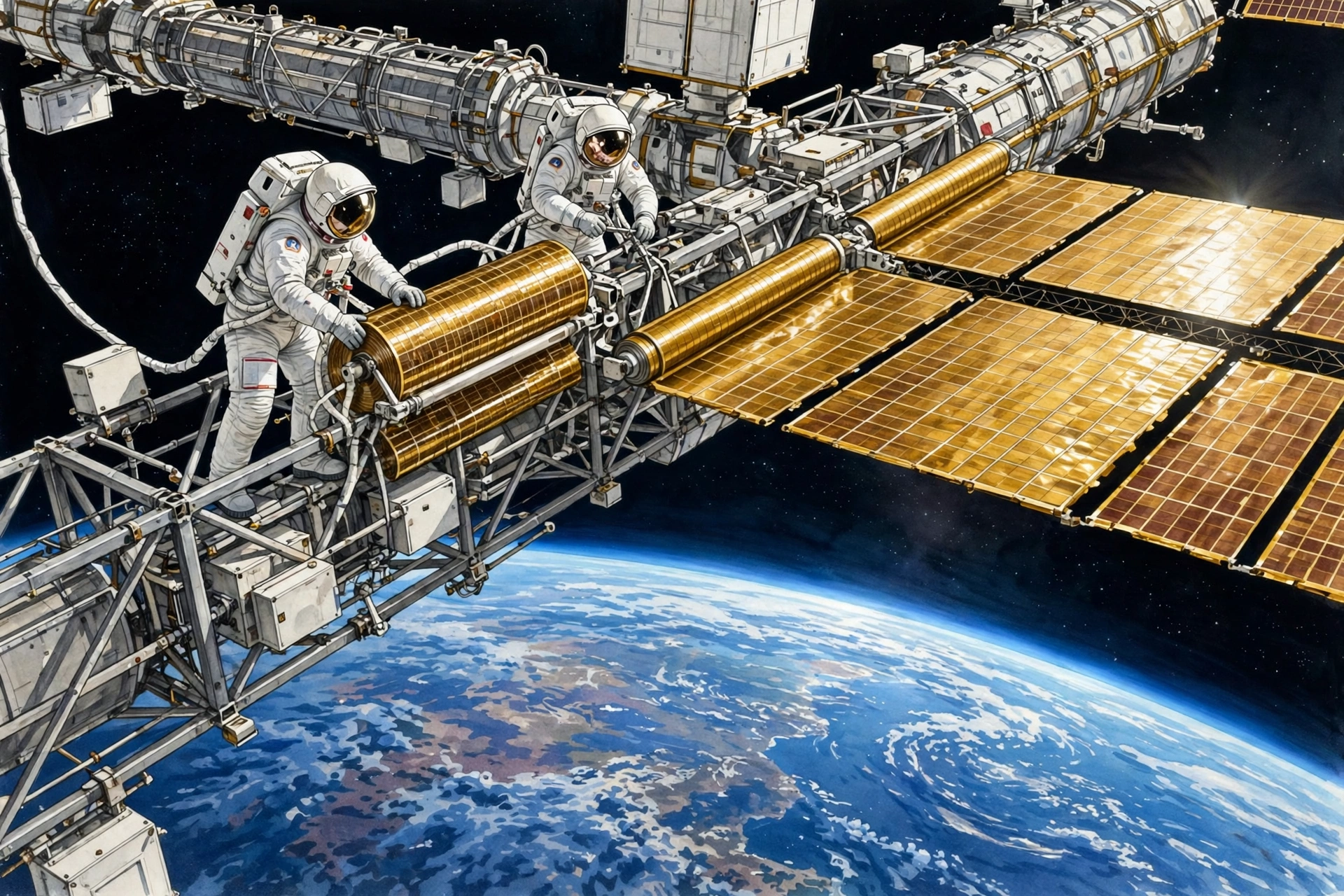
Two astronauts are due to step outside the International Space Station on Thursday, 5 November, to install the eighth and final roll-out solar array, completing a years-long effort to restore power to the orbiting laboratory.
NASA astronaut Anil Menon and Canadian Space Agency (CSA) astronaut Joshua Kutryk are scheduled to begin the spacewalk at 8:30 a.m. Eastern Time, according to a NASA station update revised on 2 November and reported by several space outlets. Live coverage on NASA+ is scheduled to start at 7 a.m. Eastern Time, and the work is expected to last about seven hours.
The outing will be the second spacewalk in this final pair. On 29 October, the same two astronauts spent 7 hours and 11 minutes outside the station installing the seventh array. That outing was counted as the 100th United States spacewalk, making Thursday’s planned excursion the 101st.
The final wing and the tricky hand-off
The last array is destined for the 3B power channel on the station’s starboard truss, at the far right end of its main structure. That location creates the day’s central challenge: it sits beyond the reach of Canadarm2, the station’s robotic arm.
The plan, as described in mission previews, is for Menon to ride the arm carrying the rolled-up array as far as it can reach. The two astronauts will then pass the array between foot restraints to move it into position for installation and deployment.
Each International Space Station Roll-Out Solar Array, known as an IROSA, measures about 60 feet long by 20 feet wide once unfurled. The arrays are far smaller than the station’s original solar wings, yet they are designed to produce a similar amount of power, helping to make up for energy lost as the older wings degraded over more than two decades in orbit.
NASA astronauts Jessica Watkins and Luke Delaney are expected to support the spacewalk from inside the station, helping the pair into and out of their suits, monitoring the excursion, and operating the robotic arm.
Why the station needs more power
The International Space Station runs on sunlight, and its power system has been asked to do more as research, commercial activity, and life-support demands have grown. The original solar arrays, launched in the station’s early years, have gradually lost efficiency with age and exposure to the space environment.
When the eighth array is in place, NASA says the station’s power-generating capacity will rise from 160 kilowatts to about 215 kilowatts, a gain the agency describes as about 30 percent. That extra capacity matters for experiments, for the systems that keep the crew alive, and for the station’s final years of operation.
The station is currently planned to be retired in 2030, with a safe and controlled deorbit at the end of its life. The completed power upgrade is intended to support critical operations through those final years, rather than to extend the station indefinitely.
A five-year upgrade, nearly done
The upgrade began in June 2021, when astronauts first started installing the new roll-out arrays alongside the ageing original wings. The work has proceeded in stages, with pairs of arrays added over successive years as hardware arrived on cargo missions and spacewalking crews became available.
Thursday’s planned spacewalk would close that chapter. For Kutryk, it would be his second spacewalk; for Menon, his fifth, according to mission previews. Kutryk, a Royal Canadian Air Force colonel and test pilot, arrived at the station on 1 October as part of the Crew-13 mission, and he became the first Canadian to walk in space since David Saint-Jacques in 2019 during the October outing.
The timing also fits into a wider moment for American spaceflight. NationWire has previously reported on a US space proclamation pledging a Moon return by 2028, and the station remains a test bed for the skills, hardware, and human endurance that longer missions will require. Research on the station includes work on how Mars dust could affect future crews, drawing on lessons from crews who spent 378 days in isolation in a simulated Mars habitat on Earth.
What to watch
Spacewalk times can shift, and NASA has already revised the start time once this week, so viewers should check the NASA+ schedule on Thursday morning. If the schedule holds, the key moments will be the opening of the Quest airlock, the hand-off of the rolled-up array beyond the robotic arm’s reach, and the slow unfurling of the final wing in sunlight.
Even if the installation goes exactly to plan, the work will not be judged complete until the array is confirmed to be generating power and secured in place. Only then will the station’s long power upgrade, five years in the making, be finished.


[…] capacity from 160 kilowatts to about 215 kilowatts, a gain NASA describes as about 30 percent. NationWire previewed the outing before the astronauts left the airlock, when the outcome still depended on a flawless day of work […]