NASA CHAPEA Crew Emerges After 378 Days in Simulated Mars Habitat
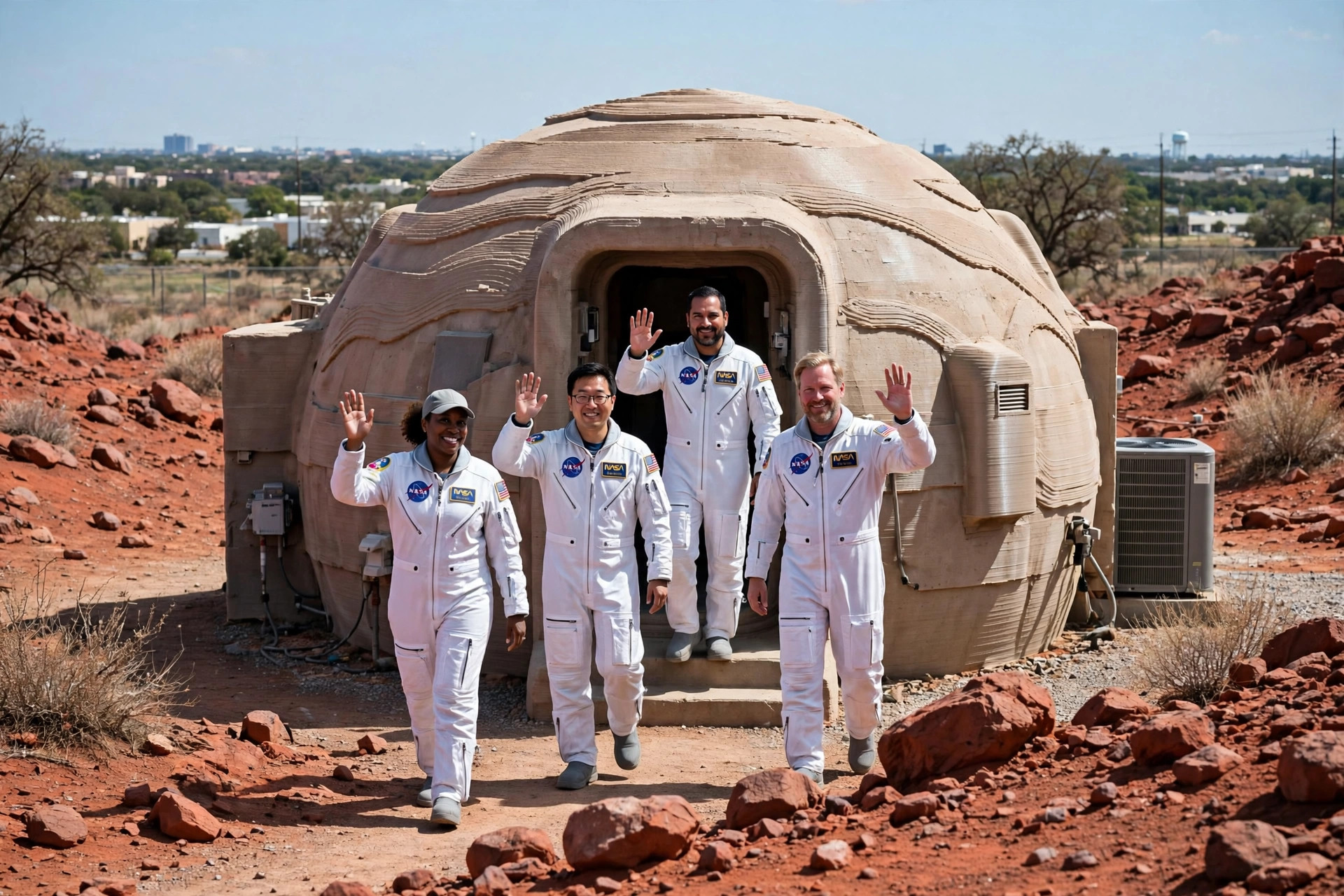
Four volunteers who spent more than a year sealed inside a simulated Mars habitat in Houston walked back into the outside world on Saturday, October 31, 2026, ending a 378-day test of what it takes to live — and stay healthy, productive and connected — far from Earth.
The crew of NASA’s second Crew Health and Performance Exploration Analog, or CHAPEA, mission emerged from the 1,700-square-foot, 3D-printed habitat at the agency’s Johnson Space Center, closing a mission that began on October 19, 2025. NASA designed the experiment to help prepare for a possible future human mission to Mars, gathering evidence about how people adapt to the routines and demands of daily life on long-duration missions beyond Earth.
“It’s been a hell of a year — analog astronauts living in captivity of our own free will,” medical officer Ellen Ellis said in remarks at Johnson Space Center after emerging with her three crewmates.
The four crew members were mission commander Ross Elder, medical officer Ellen Ellis, science officer Matthew Montgomery and flight engineer James Spicer. Johnson Space Center director Vanessa Wyche greeted them as they exited isolation, praising how they had managed with limited resources, maintained their habitat and carried out simulated Mars operations.
What the crew did inside the habitat
Inside the compact habitat, the crew lived a tightly scheduled life built around the work a real Mars crew would face. They grew crops in simulated Martian soil, maintained the habitat and its systems, and carried out simulated Mars operations, all while living with the kind of resource limits that would shape a real deep-space mission.
One of the most demanding parts of the test was communication. The crew interfaced with NASA officials through delays designed to recreate those inherent in interplanetary communications, forcing them to plan ahead rather than rely on instant replies from mission control.
“These delays require patience, careful planning and greater independence — qualities that will be essential for future astronauts traveling millions of miles from home,” Wyche said.
The isolation was also a test of endurance in close quarters. Four people shared a space roughly the size of a small apartment for more than a year, balancing research tasks, daily chores, exercise and rest — the same mix of work and routine that NASA says it must understand before sending astronauts on missions lasting years rather than months.
Why 378 days matters for the Moon and Mars
NASA has explored Mars with robotic rovers and orbiting spacecraft, but a human mission is a different challenge altogether. The agency has ambitions for a human mission to Mars as early as the 2030s, with plans before that to return astronauts to the Moon for the first time since 1972.
CHAPEA sits between those two goals. The lessons from a full year in isolation — how crews cope with limited supplies, delayed messages, confinement and repetitive routines — are meant to feed directly into planning for lunar missions first, and then for Mars.
“We have a narrowing window of opportunity to maintain US preeminence in space,” Ellis said after emerging, also pointing to the Trump administration’s plans for a service academy for space-related operations and for a lunar base. “Let’s seize the initiative, lead with science that will benefit our economy and ensure our legacy in space for our children’s children,” she said.
Elder struck a similar note about the long road ahead. “For Mars, the risks are great,” he said. “But through seeking understanding, strong vision and leadership, creativity, fortitude, hard work and incredible foundation, the goal of putting humans on Mars is not only achievable, but rather inevitable.”
What happens next for the crew
The mission does not end at the habitat door. The crew is set to participate in two weeks of post-mission evaluations and debriefing with NASA scientists, who will study their health, performance and experiences in detail.
NASA has said it is looking for insight into what it takes for astronauts to adapt to long-duration missions and to stay healthy, productive and connected. The data from CHAPEA Mission 2 — from crop growth and habitat maintenance to crew dynamics under delayed communications — will help shape how future crews are selected, trained and supported.
Wyche said the lessons learned from the CHAPEA crew and their experiences will help pave the way for missions first to the Moon and “one day, Mars.”
A second mission, building on the first
This was NASA’s second CHAPEA mission. Another four-person crew spent 378 days in isolation at Johnson Space Center spanning 2023 and 2024, and the second mission built on that experience with a new crew facing the same long stretch of simulated Martian life.
Together, the two missions give NASA more than two years of data on year-long isolation — evidence no laboratory test can fully reproduce. For an agency aiming to send people to the Moon again and then on to Mars, that lived experience may prove just as valuable as any hardware test.
On Saturday, that experience walked out of a 3D-printed habitat in Houston and back into everyday life — one step closer, NASA hopes, to the day when astronauts make the same journey for real.
Frequently Asked Questions
How long did the CHAPEA Mission 2 crew spend in isolation?
The crew spent 378 days in isolation, entering the habitat on October 19, 2025, and emerging on October 31, 2026.
Who were the four CHAPEA Mission 2 crew members?
Mission commander Ross Elder, medical officer Ellen Ellis, science officer Matthew Montgomery and flight engineer James Spicer.
Where did the simulated Mars mission take place?
At NASA’s Johnson Space Center in Houston, inside a 1,700-square-foot, 3D-printed habitat.
What was the purpose of the CHAPEA mission?
To study how astronauts adapt to the routines and demands of long-duration missions beyond Earth, including limited resources, delayed communications and life in confinement, ahead of future Moon and Mars missions.
When does NASA hope to send humans to Mars?
NASA has ambitions for a human mission to Mars as early as the 2030s, after returning astronauts to the Moon for the first time since 1972.
Sources: Reuters, “Crew from NASA’s simulated Mars mission emerges after 378 days in isolation” (November 1, 2026); The Express Tribune / Reuters, “Crew from NASA’s simulated Mars mission emerges after 378 days in isolation” (November 2, 2026).
Related coverage: NASA Asks Private Companies to Rescue the Hubble Telescope Before It Falls | Mars Dust Is Gentler Than Moon Dust — But Its Tiniest Grains Pose a New Danger