Mars Dust Is Gentler Than Moon Dust — But Its Tiniest Grains Pose a New Danger to Future Astronauts
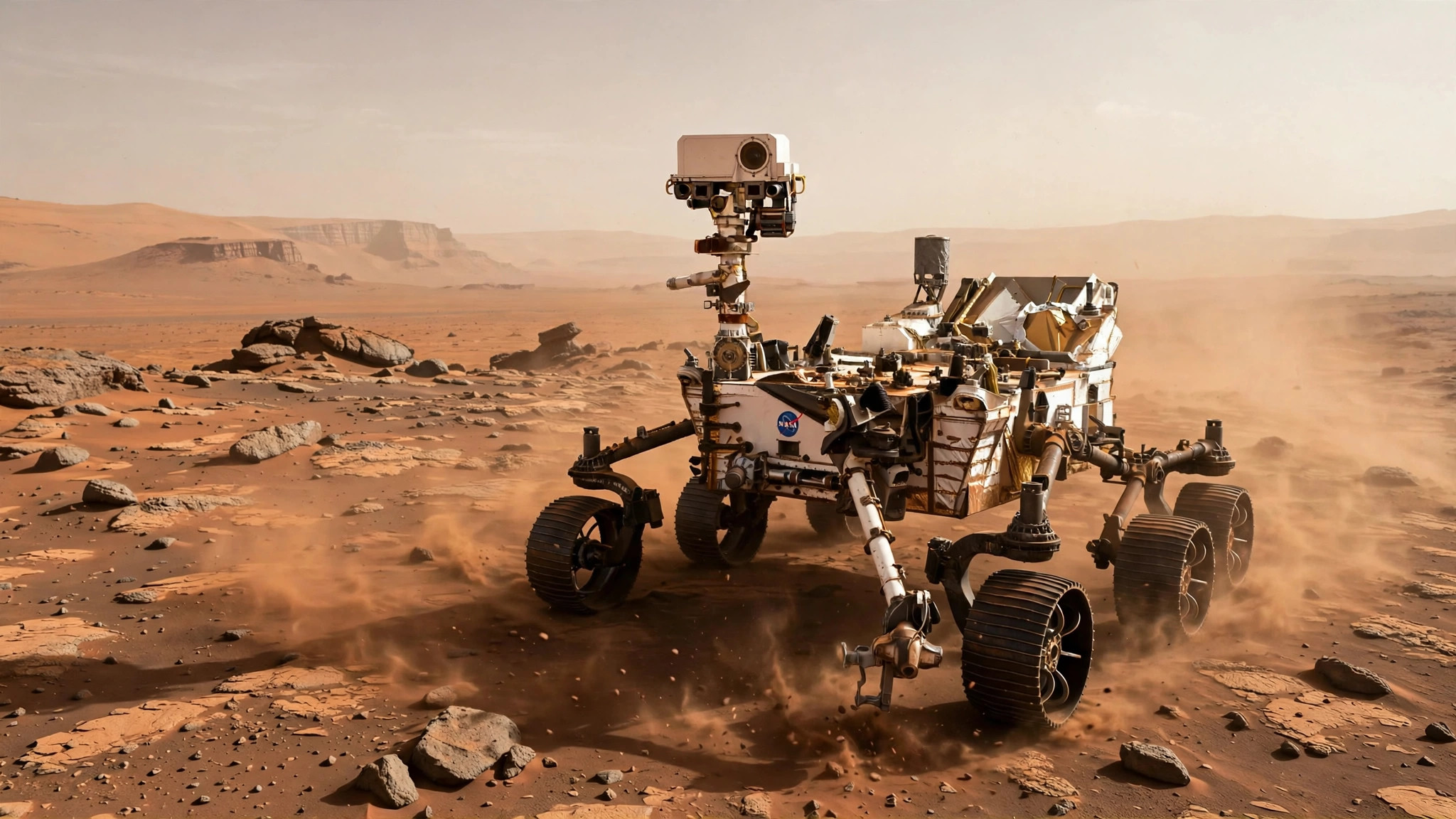
For more than five years, NASA’s Perseverance rover has carried a secret passenger across the floor of Jezero Crater: five tiny squares of spacesuit fabric, each about three-quarters of an inch across, bolted to a calibration target on the rover’s robotic arm. Nobody will ever wear them. Their job was to sit there, collect dust, and tell engineers back on Earth what future astronauts will be up against when they finally walk on Mars.
Now, after 1,645 Martian days of exposure, the verdict is in — and it is a split decision. The good news: Martian dust appears gentler on spacesuit material than the gritty lunar dust that damaged Apollo-era gear. The bad news: the finest Martian grains are so small, so clingy and so chemically hostile that they may be the single hardest problem for keeping future crews healthy.
The findings, published in the journal Proceedings of the National Academy of Sciences and led by Scott VanBommel of Washington University in St. Louis, give mission planners their first direct, on-the-ground measurements of the dust that will coat every suit, seal and airlock of a crewed Mars mission.
A very dusty place
“Mars is a very dusty place,” VanBommel said. “Astronauts to Mars will have to be prepared.”
The warning is rooted in hard experience. During the Apollo missions, lunar dust scratched helmet visors, degraded spacesuit fabric and, once tracked back inside the lunar module, contaminated the cabin air. Some astronauts reported hay fever-like symptoms after breathing it in — and those missions lasted days, not the months or years a Mars expedition would require.
Perseverance’s experiment was designed to answer a simple question: does Martian dust behave the same way? The rover carries five swatches of spacesuit material — including polycarbonate used in helmet visors, Vectran used in cut-resistant glove palms, Ortho-Fabric and two types of Teflon — mounted on the calibration target for its SHERLOC instrument. A second instrument, PIXL, carries its own Teflon and basaltic glass targets. Because PIXL cannot detect the elements in Teflon, any signal from that target had to come from dust resting on top of it.
After 1,645 Martian days — roughly four and a half Earth years — the swatches showed little visible wear. That alone is encouraging for future visitors.
Smoother grains than the moon’s
Closer inspection revealed why. Particles on Mars were much smoother than the jagged grains found on the moon, suggesting they may be less likely to scratch equipment or irritate human lungs.
“The particles in the Martian atmosphere have been blowing in the wind for potentially billions of years, so they tend to be well rounded, like pebbles in a river,” VanBommel said.
Lunar dust, by contrast, is freshly shattered rock, never softened by wind or water, with sharp edges that cut like broken glass. Martian grains have been tumbled by eons of wind into something closer to river pebbles — a meaningful difference for suits that must survive months of surface work.
But the researchers are careful not to oversell the result. The swatches are tiny, they sat on a rover rather than on a moving astronaut, and they experienced only the dust that drifted or was kicked up around Perseverance in Jezero Crater. Nobody yet knows how much wear a full suit would take through repeated movement, cleaning and use in Martian conditions.
The ultrafine problem
The more serious finding concerns size. Using PIXL’s measurements, VanBommel developed a method to estimate the size of each particle clinging to the samples. Fine dust smaller than 2.5 micrometers — comparable to the PM2.5 pollution monitored in air-quality indices on Earth — was common. And on some targets, particles ran down to roughly 100 to 300 nanometers: about 700 times thinner than a human hair.
On Earth, ultrafine particles from smoke and air pollution pose a significant health threat because they can penetrate deep into the lungs and enter the bloodstream. Astronauts will not breathe the Martian atmosphere directly, but engineers must account for these microscopic hazards when designing habitats, spacesuits and air filters.
The smallest grains also refuse to leave. Larger clumps — VanBommel calls them “Martian dust bunnies” — get shaken off over time by wind and motion. The finest particles stay behind, apparently held in place by electrostatic charge.
“The electrostatic properties of Martian dust are likely causing it to preferentially adhere to some surfaces,” said co-author Abigail Knight, a staff scientist who helped design and conduct the analysis as a doctoral student.
“The larger clumps, the Martian dust bunnies, get shaken off over time,” VanBommel said. “But the smallest particles stay behind, and those are the ones that pose the greatest challenge for human support systems.”
Toxic chemistry adds a second risk
PIXL’s data also revealed what the dust is made of — and that raises a separate concern. Unlike lunar dust, Martian material contains perchlorates and other potentially toxic compounds, and it is enriched in sulfur, iron and silica.
Brief exposure to these substances may not seriously threaten astronauts’ health; as VanBommel noted, much comes down to dose and duration. But their presence adds another risk for mission planners to weigh, especially for crews who would live and work in dusty conditions for months at a time.
NASA’s Office of the Chief Health and Medical Officer has already drafted a proposed limit for Martian dust inside crew habitats, holding particles smaller than 10 micrometers below a 24-hour average of 0.1 milligram per cubic meter for missions up to 30 days, according to a NASA working-group summary. The new measurements give engineers real numbers to design against, rather than estimates.
What this means for the first crews
No date has been set for a crewed Mars landing, and the study’s authors stress its limits: health effects were inferred from the dust’s size and chemistry, not tested on living tissue, and proposed dust-removal measures — suitports, airlocks and cleaning systems — have yet to prove they can keep dust out of crew spaces.
Still, the message is one of cautious optimism. Perseverance and previous rovers have given researchers remarkable insights into the history and current conditions on Mars. Beyond their scientific discoveries, these missions now serve as real-world tests of the technology that could one day support human exploration.
“We’ve been operating rovers on the surface of Mars continuously for more than 20 years at this point,” VanBommel said. “We know that dust will be a challenge, but it’s something we can prepare for and overcome.”
For the first astronauts to walk on Mars, the dust will not tear their suits apart the way moon dust did. It will do something quieter and harder to fight: cling, accumulate and seep into every seam. Designing for that — before anyone sets foot on the planet — is exactly what Perseverance’s five little fabric squares were sent to do.
Frequently Asked Questions
Is Martian dust dangerous to astronauts?
It poses real but manageable risks. Larger grains appear less abrasive than lunar dust, but ultrafine particles down to about 100 nanometers can penetrate deep into the lungs, and Martian dust contains perchlorates and other toxic compounds. Engineers are designing suits, airlocks and filters to limit exposure.
How did NASA measure Martian dust?
NASA’s Perseverance rover carries five small swatches of spacesuit material on a calibration target, plus Teflon and basaltic glass targets for its PIXL instrument. Researchers analyzed the dust that settled on them over 1,645 Martian days in Jezero Crater.
Why is Martian dust smoother than moon dust?
Martian grains have been blown by wind for potentially billions of years, rounding them like pebbles in a river. Lunar dust is freshly shattered rock with sharp, jagged edges that damaged Apollo spacesuits.
When will astronauts land on Mars?
No date has been set for a crewed Mars landing. The new dust measurements are meant to help engineers design the suits and habitats that will be needed whenever that mission flies.
Sources: Washington University in St. Louis / Phys.org, “Mars dust may be less abrasive than lunar dust, spacesuit samples suggest”; NASA Jet Propulsion Laboratory reporting via Nature World News; Scott J. VanBommel et al., “Fine and ultrafine Martian dust presents additional risks for future crewed missions to Mars,” Proceedings of the National Academy of Sciences (2026).
Related coverage: Phys.org: Mars dust may be less abrasive than lunar dust | Nature World News: Ultrafine Mars dust clung to spacesuit samples | PNAS study (DOI: 10.1073/pnas.2620747123)