Federal Judge Seizes Chinese-Owned Tanker After New Orleans River Crash
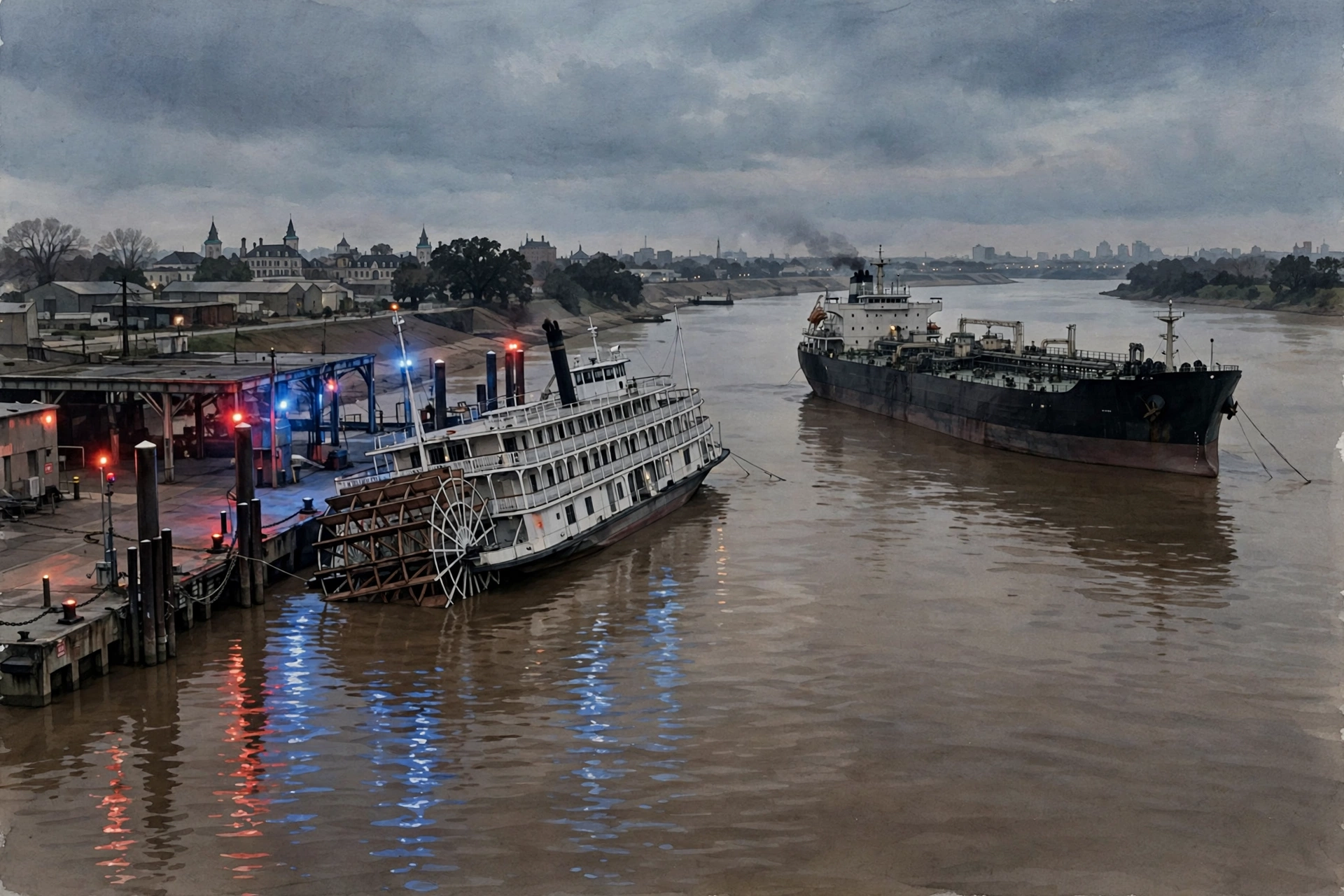
A federal judge has given United States officials control of the tanker that struck a docked river cruise boat in New Orleans, after the city’s port sued to make sure the Chinese-state-owned vessel could not leave before investigators had examined it.
The warrant, issued on Friday, hands federal authorities temporary custody of the 520-foot tanker Atlantic Asphalt. It came within hours of the collision on Friday, when the ship appeared to lose steering and slammed into the American Heritage, an American Cruise Lines paddle-wheeler docked at the Port of New Orleans’ Thalia Street Terminal.
All 197 passengers and crew aboard the cruise boat survived, as did the tanker’s crew. About 100 people ended up in the Mississippi River when the riverboat rolled onto its side against the terminal, and 32 people were taken to hospitals, including two harbour police officers who went into the water during the rescue.
A lawsuit filed within hours
The Board of Commissioners of the Port of New Orleans filed suit on Friday in the US District Court for the Eastern District of Louisiana. The complaint names the tanker, its owner Nave Shipping SA and its manager Thome Ship Management, and alleges negligence. The port says the tanker caused at least $1 million in damage to its terminal and is seeking compensation for repairs, cleanup and inspections, according to local AP coverage.
The Atlantic Asphalt sails under a Marshall Islands flag. It is owned by Nave Shipping SA, a company registered in Monrovia, Liberia, according to the International Maritime Organization. MarineTraffic, a live shipping tracker, lists Nave Shipping as a subsidiary of China State Shipbuilding Corporation, a sprawling Chinese state-owned conglomerate. The company did not respond to a request for comment, The Associated Press reported.
The port moved quickly because the vessel’s ownership chain runs through a foreign state-owned group. The lawsuit was designed to ensure federal investigators could seize the ship before it sailed on, and the judge’s warrant gave them control of it for now. The tanker has since been towed away from the crash site to Perry Street Wharf.
The black box is recovered
The National Transportation Safety Board, which leads the federal investigation, said on Saturday that its team had recovered the tanker’s voyage data recorder — the maritime equivalent of an aeroplane’s black box. The recorder logs the ship’s speed through the water, direction and course, along with audio from the bridge, evidence investigators hope will explain why the 520-foot vessel appeared to lose steering before the impact.
NTSB member John DeLeeuw said the agency has 16 investigators on site and is scheduling interviews with those involved. Over the next week, the board plans to interview witnesses, examine both vessels, gather video and send divers into the river. A preliminary report is expected within about 30 days, while a full report, including the cause, could take 18 to 24 months.
Coast Guard Captain Melanie Burnham told reporters on Saturday that the tanker appeared to experience “some type of loss of steering” before impact, but the exact cause of the crash is not yet known. The NTSB is sending investigators to New Orleans to examine the event, and the board recovered the recorder within hours of arriving.
A salvage job that could take weeks
The American Heritage remains on its side against the terminal, partly submerged in about 25 feet of water. The first step is to remove the roughly 16,000 gallons of fuel still aboard safely, Burnham said. Only then can crews begin the work of righting the vessel, which officials estimate could take weeks.
The riverboat had been docked for about two hours and was finishing an eight-day Mississippi River cruise when the tanker struck it at mile 96 of the Lower Mississippi. The Atlantic Asphalt, built in 2017, carries asphalt and bitumen for construction use and had New Orleans as its final destination, according to MarineTraffic.
The crash has put a spotlight on America’s fastest-growing cruise niche. River cruising on the Mississippi has expanded rapidly in recent years, with more and larger paddle-wheelers working the river alongside heavy commercial traffic. It is another transport collision under investigation this month, after two jets clipped each other on a Miami taxiway, and it comes days after a nationwide ground stop halted flights across the United States — a reminder of how quickly a single failure can cascade through transport networks. The NTSB investigation will now examine how a loaded tanker lost control in one of the busiest stretches of the river, and whether anything in its steering or bridge procedures failed before the collision.
For now, the questions are narrow: what the recorder shows, what the crew says, and what the divers find. The answers will take months. But the seizure itself is already settled — the Atlantic Asphalt is not going anywhere until the federal investigation says otherwise.
FAQ
Why did a judge seize the tanker?
The Port of New Orleans sued within hours of the crash, alleging at least $1 million in terminal damage, and a federal judge issued a warrant giving federal officials control of the Atlantic Asphalt for now so investigators could examine it before it left.
Who owns the Atlantic Asphalt?
It is owned by Nave Shipping SA, registered in Monrovia, Liberia, and listed by MarineTraffic as a subsidiary of China State Shipbuilding Corporation, a Chinese state-owned conglomerate. It sails under a Marshall Islands flag and is managed by Thome Ship Management of Singapore.
What will the NTSB investigation find?
The board has recovered the voyage data recorder, which logs speed, direction, course and bridge audio. A preliminary report is expected in about 30 days; a final report with the cause could take 18 to 24 months.

