Oldest Quasar Pair Ever Found Defies Black Hole Growth Theories
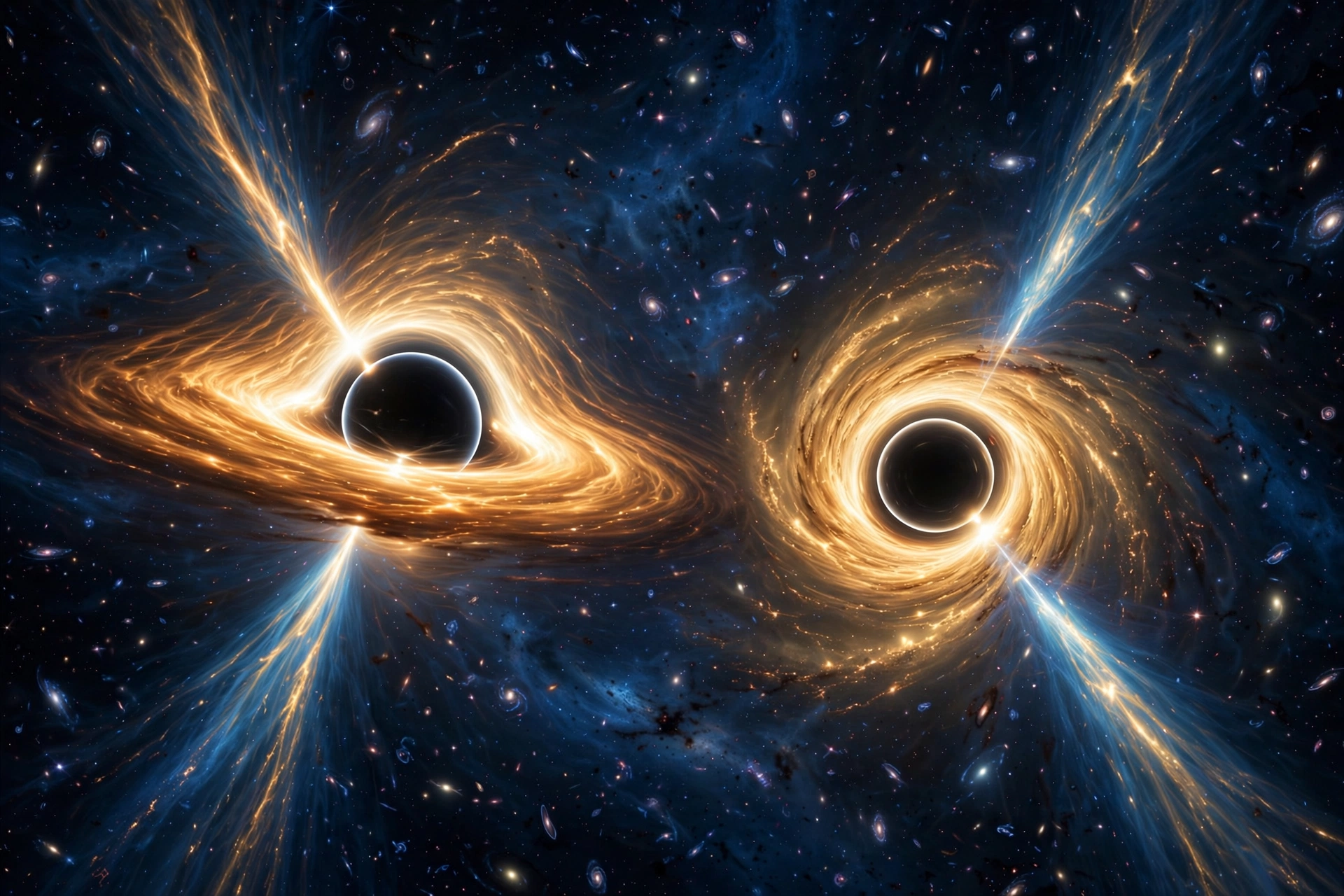
Astronomers have found the oldest compact pair of quasars ever observed, two supermassive black holes shining brightly just 900 million years after the Big Bang. The discovery, announced by NSF NOIRLab on 10 November 2026, challenges current ideas about how black holes could grow so large so early in the history of the Universe.
The system, formally designated J1602+4228AB, has been given the Hawaiian name Nāpōwawāʻenakaulua. It sits at a redshift of 6.08, more than 12.9 billion light-years away in the direction of the constellation Boötes. When its light began its journey, the Universe was only about a thirteenth of its present age.
Quasars are the brilliant centres of distant galaxies, powered by supermassive black holes feeding on surrounding gas and dust. Finding one such giant in the early Universe is already a puzzle for theorists. Finding two, close together, is harder still to explain.
Two giants, remarkably close together
The larger black hole in the pair weighs about 1.5 billion times the mass of the Sun. Its companion weighs about 400 million solar masses. The two are separated by only about 18,100 light-years, roughly a fifth of the diameter of the Milky Way, or 5.56 kiloparsecs.
That closeness is what makes the find so unusual. Nāpōwawāʻenakaulua is only the third quasar pair known from the era called cosmic dawn, and it is the most compact pair yet found from that period. The pair was uncovered in data from the Aether survey, a James Webb Space Telescope programme led by Emanuele Paolo Farina of NSF NOIRLab, which examined about 200 quasars from the early Universe.
Silvia Onorato, a postdoctoral research associate at NSF NOIRLab who led the study, said: “There is no definitive theoretical explanation for how a single one of these giant quasars exists so early in the age of our Universe, much less two.”
The discovery was confirmed using the Gemini Near-Infrared Spectrograph on the Gemini North telescope on Maunakea in Hawai’i, after the pair was first spotted in observations by the Webb telescope’s Near-Infrared Spectrograph. The findings were published in the peer-reviewed journal The Astrophysical Journal Letters on 10 November 2026.
Why the pair should not exist yet
Black holes grow by pulling in gas and by merging with other black holes, but both processes take time. In the first billion years after the Big Bang, there should have been little time for a black hole to reach 1.5 billion solar masses, let alone for two such objects to form side by side.
The numbers underline how surprising the result is. A single close pair turned up in 199 fields searched by the survey, while clustering forecasts predicted 100 to 1,000 times fewer such pairs.
The result adds to a growing set of Webb discoveries that suggest the first black holes grew faster than many models predicted, perhaps from unusually massive seeds, from periods of rapid feeding above the usual limits, or from frequent mergers in dense early environments. None of those explanations is yet settled, and the new pair gives theorists a sharper test case because it constrains two objects at once, not just one.
A lensing check still to come
The team is careful about one alternative explanation. A massive object sitting between Earth and a distant quasar can bend its light and create the false appearance of a second, fainter source, a phenomenon known as gravitational lensing.
In this case, the spectra of the two quasars differ in shape, which leads the researchers to favour a genuine physical pair over a lensing illusion. A full lens model will still be needed before lensing can be ruled out definitively, and the paper presents that caveat openly.
If confirmed as a real pair, the two black holes are likely to merge eventually, sending ripples through space-time.
What happens next
Further observations should pin down the masses and feeding rates of both black holes more precisely, and test whether their host galaxies are themselves merging. Webb has already shown its power in this field, from studying the interstellar comet 3I/ATLAS to finding 27 icy worlds beyond Neptune, and the ageing Swift telescope has also spent years watching the high-energy sky.
For now, Nāpōwawāʻenakaulua stands as the most distant compact quasar pair known, a system that should not exist under current theory, yet plainly does. As reported by Phys.org, the team says the pair’s black holes are just as massive as those seen today, despite being observed when the Universe was only a thirteenth of its age. Explaining how they got there is now one of the sharpest questions in early-Universe astronomy.