Webb Finds Interstellar Comet 3I/ATLAS Carries Record Heavy Hydrogen From a Frigid, Ancient Birthplace
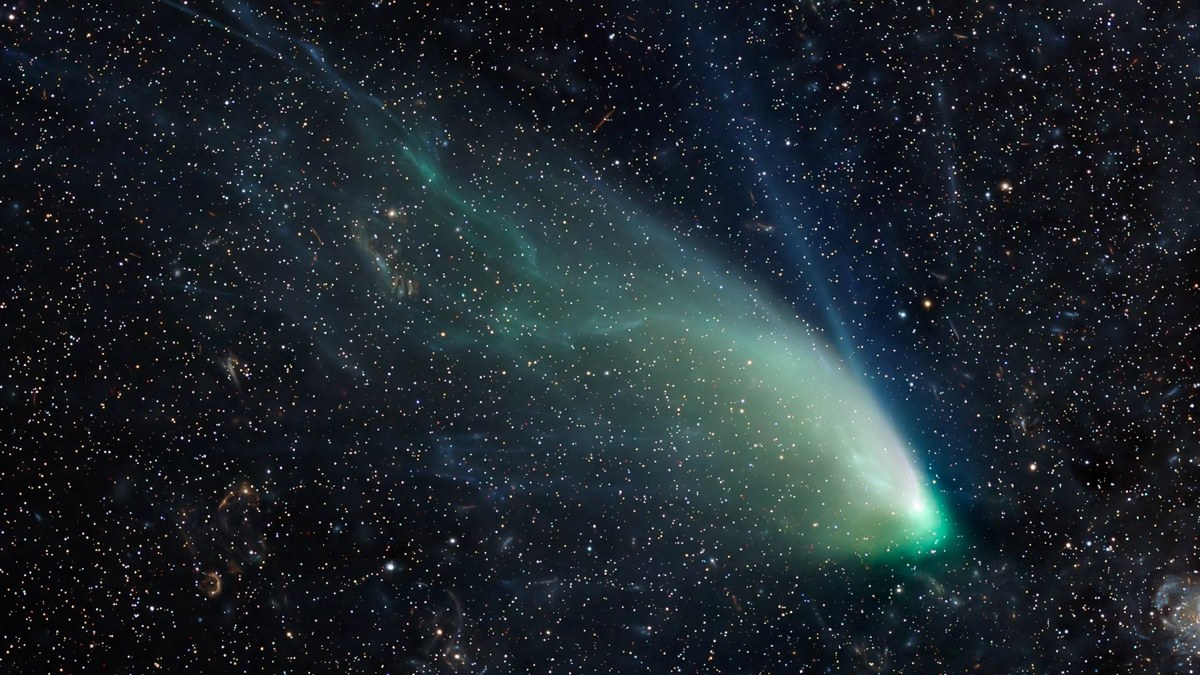
An icy visitor from another star system has just given astronomers one of the most striking chemical measurements ever made beyond our solar system. Using NASA’s James Webb Space Telescope, researchers have found that the methane escaping from interstellar comet 3I/ATLAS is unusually rich in heavy hydrogen — a clue that its frozen ingredients formed in an intensely cold place, long before the comet ever reached our Sun.
The finding, published in the journal Nature Astronomy, does not just add another detail to 3I/ATLAS’s file. It gives scientists a rare, direct sample of the chemistry of another planetary system’s birthplace, carried across interstellar space and delivered to our doorstep.
What Webb actually measured
Webb observed 3I/ATLAS on December 22 and 23, 2025, when the comet was about 2.4 times as far from the Sun as Earth. The telescope studied infrared light from the coma, the cloud of gas surrounding the comet’s icy nucleus, and separated the faint fingerprint of heavy methane from the much brighter glow of ordinary methane.
Heavy hydrogen, known as deuterium, is a form of hydrogen with an extra neutron in its nucleus. When it replaces an ordinary hydrogen atom in methane — a molecule made of one carbon atom and four hydrogen atoms — it changes the molecule’s infrared signature just enough for Webb to tell the two apart.
The team, led by Nathan Roth of American University and NASA’s Goddard Space Flight Center, measured a deuterium-to-hydrogen ratio of about 3.2 percent in the comet’s methane, reported more precisely as 3.18 percent, plus or minus 0.30 percent. In plain terms, roughly one hydrogen atom in every 31 in that methane was the heavy kind.
“This D/H ratio exceeds any other value for methane measured in the solar system,” the authors write.
Thirteen times the local comparison
The comparison that makes the result so remarkable comes from comet 67P/Churyumov-Gerasimenko, a Jupiter-family comet thought to have formed in our own solar system’s Kuiper Belt. It is the only other comet in which deuterium-bearing methane has been securely detected — and that measurement required the European Space Agency’s Rosetta spacecraft to fly through the comet’s coma and sample it directly.
Webb made its measurement from afar. Yet the methane ratio in 3I/ATLAS came out about 13 times higher than Rosetta’s value for 67P, which was about 0.24 percent. No methane measured anywhere in our solar system comes close to the 3I/ATLAS figure.
The result also differs from earlier measurements of 3I/ATLAS itself. The methane ratio was roughly three times the ratio previously measured in the comet’s water, suggesting that the methane may have formed later, after the surrounding chemistry had more time to concentrate heavy hydrogen.
Why cold makes heavy hydrogen
An extra neutron may sound like a small detail, but in astrochemistry it is a powerful thermometer and clock. In extremely cold gas, chemical reactions favor putting deuterium into molecules. At temperatures around 10 degrees above absolute zero — about minus 263 degrees Celsius — the reactions that would undo that enrichment become less effective, and reactions on the surfaces of interstellar dust grains can build deuterium-rich ice.
That ice can later become part of a comet. So a high deuterium ratio is, in effect, a memory of the cold where the ice was born.
The researchers argue that the new measurement fits a birthplace in a cold, low-metallicity interstellar or protostellar environment — a region with relatively few elements heavier than helium — exposed to a high rate of cosmic-ray bombardment. Those energetic particles help start the reactions that enrich molecules in deuterium.
A visitor from another star system
3I/ATLAS was first reported on July 1, 2025, by the ATLAS survey telescope in Chile. It is only the third confirmed interstellar object ever discovered passing through our cosmic neighborhood, following 1I/‘Oumuamua and 2I/Borisov.
The comet reached its closest approach to the Sun around October 30, 2025, at a distance of about 1.4 astronomical units — roughly 130 million miles, just inside the orbit of Mars — and it poses no threat to Earth. By the time Webb studied it in late December, it was already moving away, still shedding gas that astronomers could analyze from millions of miles away.
What the result does not prove — yet
The researchers are careful about the limits of the finding. The measurement offers a plausible history, not a uniquely identified birthplace. Direct measurements of methane’s deuterium ratio in distant star-forming environments, which scientists would need for a like-for-like comparison, are still lacking. And the few chemical models that report such estimates fall short of the value measured in 3I/ATLAS.
That gap is itself useful. Any description of how 3I/ATLAS’s ingredients formed must now explain why its methane contains so much heavy hydrogen. The comet has set a demanding new test for models of how planets and comets are born around other stars.
It is also worth separating what this study measured from wider claims about the comet’s age. The new paper measures chemistry, not a birthday. Other isotope work on 3I/ATLAS has been used to argue for a very ancient origin, but the headline number here is the chemistry itself: a methane deuterium ratio higher than anything measured in our solar system.
Why Americans should care
For American readers, the story is also a showcase for a flagship US observatory doing exactly what it was built to do. Webb, operated with NASA, the European Space Agency and the Canadian Space Agency, can detect faint chemical fingerprints that no earlier telescope could separate — in this case, a whisper of heavy methane hidden between the much brighter features of ordinary methane.
Frequently asked questions
What is 3I/ATLAS?
3I/ATLAS is an interstellar comet discovered on July 1, 2025, by the ATLAS survey in Chile. The “3I” marks it as the third confirmed interstellar object found passing through our solar system.
What did the James Webb Space Telescope find?
Webb measured a deuterium-to-hydrogen ratio of about 3.2 percent in 3I/ATLAS’s methane, about 13 times higher than the value measured in comet 67P, the only other comet with a securely detected deuterium-bearing methane signal.
What is deuterium?
Deuterium is heavy hydrogen: a hydrogen atom with an extra neutron. It can replace ordinary hydrogen in molecules such as methane, changing their infrared fingerprint and revealing the conditions where the molecule formed.
Does this mean 3I/ATLAS is older than the Sun?
Not directly. The new study measures chemistry, not age. Its authors interpret the high deuterium level as consistent with ice formed in a very cold, ancient environment, but the paper itself does not date the comet.
Is 3I/ATLAS dangerous to Earth?
No. The comet passed the Sun at about 1.4 astronomical units in late October 2025 and poses no threat to Earth.
Sources: Roth et al., “An enriched methane D/H ratio in the interstellar object 3I/ATLAS,” Nature Astronomy (2026), DOI: 10.1038/s41550-026-03002-5; Phys.org, “Heavy hydrogen in 3I/ATLAS’s methane points to a frigid birthplace”; ScienceAlert, “Interstellar Visitor 3I/ATLAS Just Got Even Weirder”; The Economic Times, “Interstellar comet 3I/ATLAS has 13 times more deuterium than a famous Solar System comet.”