New Zealand Election Ends in Deadlock as National and Labour Tie
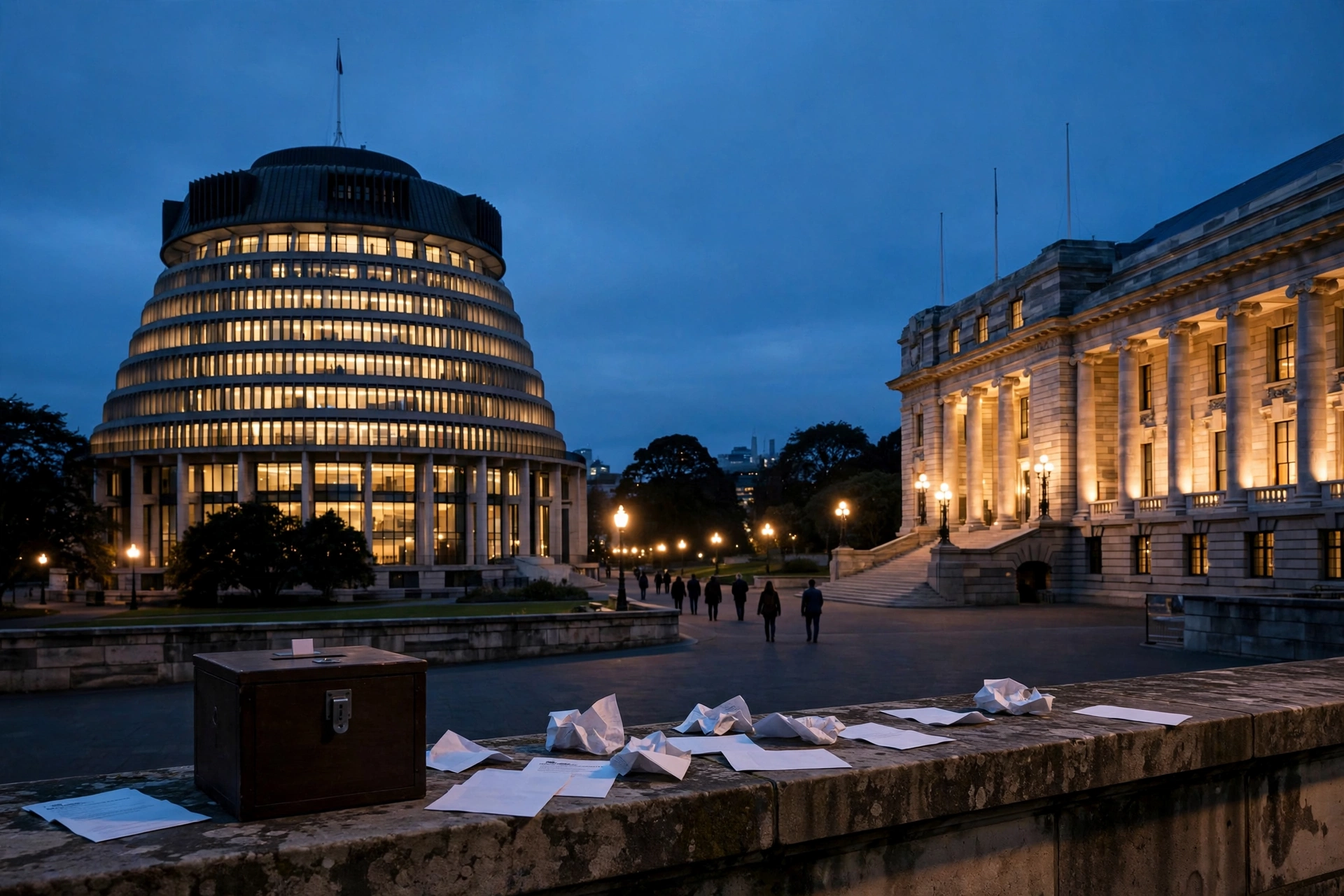
New Zealand woke on Sunday without knowing who will govern it, after Saturday’s general election ended in a near-perfect deadlock between the two major parties and left the shape of the next government to coalition talks and hundreds of thousands of special votes.
With more than 99 per cent of votes counted, Prime Minister Christopher Luxon’s centre-right National Party and the opposition Labour Party were separated by only a fraction of a percentage point in the party vote. National stood on 29.3 per cent and Labour on 29.2 per cent, a gap of roughly 2,500 votes out of nearly 2.38 million counted, according to preliminary figures reported by RNZ.
Neither bloc won a decisive mandate. National, with 42 seats, remains the largest party in Parliament, but it is well short of the seats it would need to govern alone. Together with its coalition partners, the libertarian ACT Party on 13 seats and the populist New Zealand First on 12, the centre-right grouping would hold 67 seats in a 130-seat Parliament — a wafer-thin total, just one seat above the 66 needed to govern.
The left-leaning bloc of Labour, the Greens and Te Pāti Māori stood on 56 seats on the preliminary count, with the new centrist Opportunity Party — which entered Parliament for the first time — holding seven seats and a potential kingmaker role.
A kingmaker enters Parliament
The story of election night was the breakthrough of Opportunity. The centrist party, led by Qiulae Wong, crossed the five per cent threshold needed to enter Parliament for the first time since its founding in 2017, taking about six per cent of the party vote and seven seats.
Wong said the party was open to working with either of the major blocs, although it would negotiate first with the party that won the most seats. That position puts Opportunity at the centre of whatever government takes shape, particularly if the special votes shift the balance when they are counted.
The Greens recorded their best-ever national vote, on 13.3 per cent, while ACT also posted a record result on about 11 per cent. New Zealand First took 9.8 per cent. Te Pāti Māori, which represents Māori interests, won five seats.
Taken together, the two major parties won only around 60 per cent of the vote between them — historically low support that underlined how fragmented New Zealand politics has become under its mixed-member proportional system, in use since 1996.
No concession, no certainty
Luxon told supporters at Auckland’s Viaduct Events Centre that National was once again the largest party in Parliament and claimed a pathway to power, though he acknowledged the result would not be known for weeks. Opposition leader Chris Hipkins, whose Labour Party won 35 seats on the preliminary count, showed no sign of conceding.
The result will not be settled until the Electoral Commission counts the special votes — ballots cast outside a voter’s home electorate, including votes from overseas — and declares the official result on 27 November. Around 500,000 special votes are yet to be counted, and they have historically favoured the left, meaning the centre-right’s one-seat edge could yet disappear.
AAP reported that coalition negotiations could then stretch toward Christmas, leaving New Zealand in caretaker mode for weeks.
The campaign was dominated by the cost of living and the economy. Unemployment climbed to 5.7 per cent in the September quarter, its highest in more than a decade, and housing affordability was a central issue for voters. New Zealand’s election followed a week of dramatic votes elsewhere: Paraguay’s Senate removed its president on Friday over a banking collapse, Democrats won six new state trifectas in the United States, and Bulgaria’s presidential run-off delivered a win for Iliyana Iotova.
What happens next
The immediate focus is the special-vote count, due on 27 November. Once the official result is declared, the Governor-General will invite the party or grouping that can command a majority in Parliament to form a government — a process that could take days or weeks of negotiation between National, ACT, New Zealand First and, potentially, Opportunity.
For now, New Zealanders face an unusual wait. The country has had close elections before, but rarely one in which the two largest parties were separated by a few thousand votes and the final say rests with ballots that will not be counted for another three weeks. The full preliminary results show just how narrow the margin is — and how much can still change before a government is formed.