Trump Hosts Syria’s Al-Sharaa in First White House Visit by a Syrian Leader
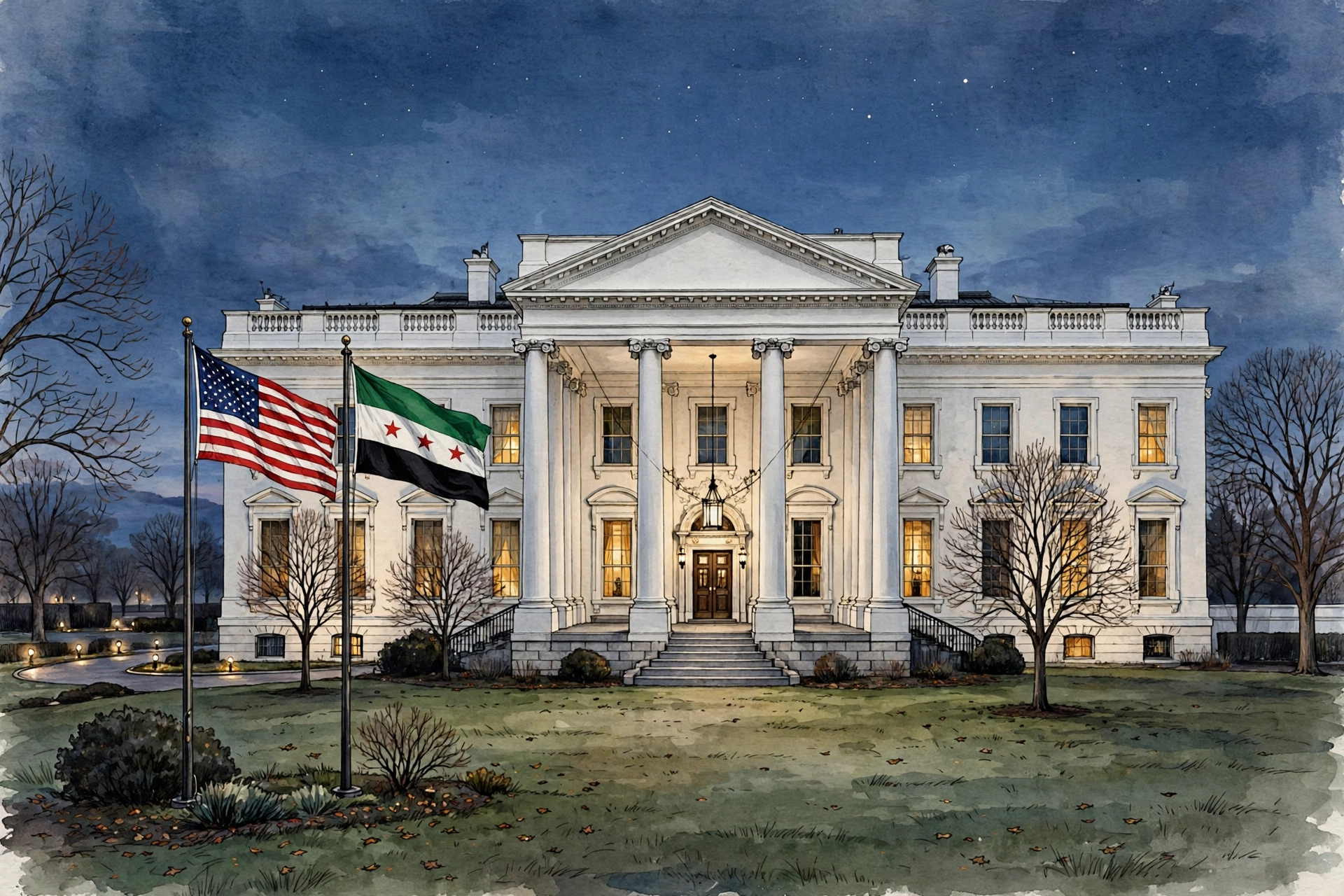
President Donald Trump hosted Syrian President Ahmad al-Sharaa at the White House on Monday, in the first visit by a Syrian head of state since Syria gained independence from France in 1946. The meeting, held behind closed doors in the Oval Office, capped a remarkable turnaround for a leader who, until recently, was a wanted man with a $10 million US bounty on his head.
A two-hour meeting behind closed doors
Al-Sharaa arrived at the White House a little after 11:30 a.m. and began his Oval Office meeting shortly afterwards. Unusually for a visiting head of state, he entered through West Executive Avenue, rather than the West Wing driveway used for other foreign leaders’ arrivals, and no reporters or cameras were admitted. He left about two hours later, greeting a crowd of supporters outside before joining his motorcade.
White House press secretary Karoline Leavitt said the visit was “part of the president’s efforts in diplomacy to meet with anyone around the world in the pursuit of peace.”
Afterwards, Mr Trump wrote on Truth Social: “It was an Honor to spend time with Ahmed Hussein al-Sharaa, the new President of Syria, where we discussed all the intricacies of PEACE in the Middle East, of which he is a major advocate.”
The Straits Times reported that the closed-door format was unusual for the normally camera-friendly Mr Trump, with both the arrival and the meeting kept away from the media.
Sanctions eased and a coalition role for Damascus
Alongside the meeting, the Treasury Department announced a fresh 180-day suspension of mandatory Caesar Act sanctions on Syria, aimed at supporting the country’s economic rebuilding. Secretary of State Marco Rubio said: “Today, I issued a suspension of mandatory Caesar Act sanctions based on the actions taken by the Syrian government following the fall of the al-Assad regime.”
Syria also agreed to join the US-led global coalition fighting the Islamic State group, a step Xinhua reported was a central aim of the talks. Damascus is seeking a permanent repeal of the sanctions, which would require Congress to act, while Washington wants Syria inside the coalition fighting the Islamic State group.
Syrian officials also confirmed that Damascus had signed a “political cooperation declaration” with Washington.
Mr Trump is also reported to be pressing Damascus to join the Abraham Accords, the agreements under which Israel normalised relations with several Arab states.
From bounty to the Oval Office
Al-Sharaa led the rebel forces that toppled Bashar al-Assad last December and was named the country’s interim leader in January, ending the Assad family’s half-century in power. He was once affiliated with al-Qaeda and led the Nusra Front, the network’s Syrian affiliate, before breaking with al-Qaeda in 2016 and leading Hayat Tahrir al-Sham.
Washington delisted Hayat Tahrir al-Sham as a terrorist organisation in July, and removed al-Sharaa himself from its terrorism blacklist on 7 November. The UN Security Council voted last week to remove al-Sharaa and interim interior minister Anas Khattab from its sanctions list for Islamic State and al-Qaeda.
Mr Trump and al-Sharaa first met in May in Saudi Arabia, in the first official encounter between American and Syrian leaders since 2000, when President Bill Clinton met Hafez al-Assad, the father of Bashar al-Assad.
Michael Hanna, the US programme director at the International Crisis Group, called the visit “a hugely symbolic moment for the country’s new leader, who thus marks another step in his astonishing transformation from militant leader to global statesman.”
What comes next
The visit leaves the hardest questions open. A permanent end to the Caesar Act sanctions needs Congress, and the administration has yet to say what Syria’s role in the anti-Islamic State coalition will involve in practice. The White House is also pursuing negotiated settlements elsewhere, including the talks in Abu Dhabi between Russia and Ukraine.
The visit followed a meeting of allied foreign ministers in Paris, where Ukraine and Iran topped the agenda.