Southwest Flooding: New Atmospheric River Threatens Arizona and New Mexico
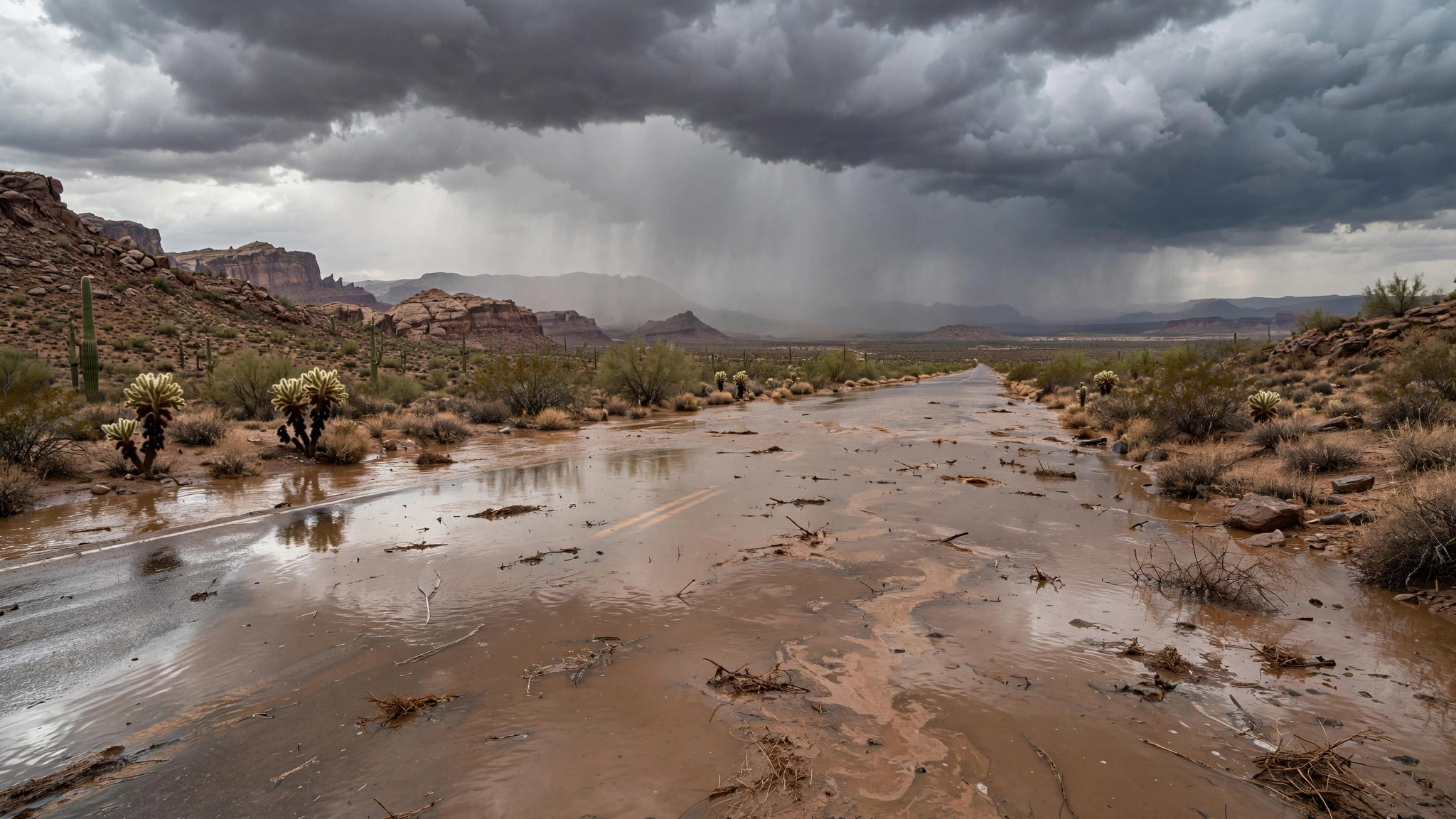
The American Southwest is bracing for another dangerous round of flooding on Sunday, as a new atmospheric river moves into a region where the ground is already saturated, rivers are still swollen, and many communities have barely begun to clean up from weeks of storms.
Forecasters warn that the latest system, carrying tropical moisture from the Pacific, could drop more than 4 inches of rain in some areas starting late Saturday. In a landscape that has absorbed storm after storm since September, even that amount can turn normally dry washes, desert roads and mountain streams into fast-moving floodwaters.
The threat stretches across Arizona, New Mexico, Nevada, Utah and Colorado, with flood watches in place for much of Arizona and parts of the other four states through Monday, November 2. The National Weather Service has urged residents to monitor warnings closely, avoid flooded roads, and be ready for conditions to change quickly.
New storm arrives on saturated ground
The central problem, forecasters say, is not just how much rain falls, but what it falls on. Weeks of El Niño-enhanced storms have left soils unable to absorb much more water.
“Our main concern is just how saturated soils are already,” Joshua Schank, lead forecaster for the National Weather Service office serving Flagstaff, Arizona, told Bloomberg. “It can’t hold the moisture it’s already had to contend with over the last three to four weeks.”
Traditionally, the heaviest rains linked to El Niño arrive in the winter months. This year, warming oceans and a run of tropical storms and hurricanes enhanced by El Niño have sent moisture pouring into the Southwest since September, threatening monthly rainfall records in parts of Arizona and New Mexico.
Some of the storms have also dropped golf-ball-sized hail, and rare tornadoes have touched down in Arizona and western New Mexico, including in the mostly arid city of Santa Fe, according to New Mexico State Climatologist Dave DuBois.
“Moisture doesn’t usually go as far west,” DuBois said. “It’s pretty extraordinary.”
Four Corners and the Navajo Nation still recovering
The rainfall has been especially intense in the Four Corners region, where Arizona, Utah, Colorado and New Mexico meet. A spate of storms that began on October 20 caused catastrophic flooding along the San Juan River, which overtopped its banks and inundated communities on the Navajo Nation reservation and in rural parts of New Mexico.
Raw sewage washed into the waterway as floodwaters spread, turning some neighborhoods into hazardous cleanup zones. At least two people were found dead after the rains receded, and a week later some residents were still unable to return home.
“With current hazmat concerns and potential for more rainfall soon, re-entry remains hazardous,” officials in San Juan County, New Mexico, said in a safety bulletin on Friday.
There has been little time for rivers and streams to recover between storms. Forecasters say the Southwest may get a brief reprieve early next week, but the chances of rain will build again heading into next weekend.
Phoenix and Las Vegas rescues show flash-flood danger
The danger was already on display on Friday, October 30, when heavy rain triggered rescues across Arizona and Nevada.
In the Phoenix metropolitan area, firefighters rescued people from four vehicles during Friday evening’s storms. Nearby Scottsdale also saw hazardous conditions, with crews responding to vehicles surrounded by floodwater estimated at three to four feet deep. In western Arizona, intense rainfall in Bullhead City washed rocks, debris and water onto streets, and authorities closed parks because conditions were unsafe.
In southern Nevada, the flooding turned deadly near Las Vegas. Emergency crews carried out several swift-water rescues in the Henderson area on Friday. One person was rescued from the roof of a stranded vehicle, and two others were rescued after their vehicle was swept from the roadway. Another person was rescued from a drainage wash but later suffered cardiac arrest and died at a hospital, according to reports citing local authorities.
Since September, emergency crews have conducted hundreds of water rescues in neighborhoods cut off by floodwaters across the Southwest, as storms have repeatedly overwhelmed drainage systems, roads and bridges.
What forecasters expect through Monday
The National Weather Service has warned of major river flooding at Pagosa Springs, Colorado, and dangerous conditions on roads across the region. The next storm system is expected to push across the West, bringing heavy rainfall and significant flash flooding to the Four Corners region, with high-elevation snow in some mountain areas.
By Monday, rain and wind are expected to reach the Central Plains, with Kansas, Oklahoma and Texas facing a possible tornado threat as well, according to the Weather Prediction Center.
A flood watch means conditions are favorable for flooding, not that every location in the watched area is already flooding. Forecasters stress that flash floods in desert communities can develop suddenly, even in places that have seen only brief rainfall, because water moves rapidly through normally dry channels and low-lying roads.
Travelers planning trips to national parks, desert canyons and mountain recreation areas are advised to check forecasts and local access restrictions before setting out, and air travelers should monitor airline and airport updates if thunderstorms develop near their departure or arrival airport.
Aid question in New Mexico
In New Mexico alone, officials have said recovery costs may exceed $200 million. Roads, drainage, sidewalks and bridges will need repairs, and some towns have launched intensive cleanup efforts after repeated flooding.
“Our road crews cleared debris around the clock, and our counties and tribal nations spent money they don’t have to keep people safe,” Democratic Governor Michelle Lujan Grisham said in a statement on Thursday, adding that the state planned to seek funding from “federal partners” to defray costs.
While the Federal Emergency Management Agency can help reimburse some expenses, larger outlays require a major disaster declaration from President Donald Trump. So far, Trump has approved only limited aid for emergency response in New Mexico, according to Bloomberg. Other southwestern states have yet to publicly request aid.
White House spokesperson Lauren Bis said FEMA and other federal agencies have been “on the ground in affected areas” to provide water, technical assistance and support with incident management, infrastructure site assessments and communications.
A wet fall with a double edge
Though destructive and deadly, the storms have also brought much-needed snow at higher elevations, laying a foundation for the Southwest’s snowpack and water supplies in the months ahead. El Niño is expected to further boost the odds of wet weather as it peaks later this winter.
Drought forecasters caution that a single extra-snowy winter would not be enough to fully restore the region’s reservoirs. But extra rain and snow may help soften the contours of the intense, multiyear drought that has settled over the Southwest, DuBois said.
Dry conditions have imperiled the Rio Grande and the Colorado River, a source of water for more than 40 million people in seven states and the engine behind roughly $1 trillion in economic activity.
“It all benefits the environment and ecosystem, but in terms of water use for agriculture, it really helps to have a good, wet fall,” DuBois said. He added, “but not too much.”
How to stay safe during flash flooding
Emergency officials repeat one rule above all: never drive through flooded roads, even if the water looks shallow. Just a few inches of fast-moving water can sweep a vehicle away, and the road beneath may be washed out entirely.
Residents in flood-prone areas should move to higher ground if told to do so, avoid walking through floodwater, and keep phones charged for emergency alerts. Hikers should stay out of narrow canyons and dry washes when storms are forecast, since flash floods can arrive with little warning from rain falling miles upstream.
With more rain expected through Monday and another wet pattern possible next weekend, officials say the safest course is to treat every flood watch in the Southwest this weekend as a reason to check local warnings before traveling — and to turn around, not through, when water covers the road.
Frequently asked questions
Which states are under flood watches?
Much of Arizona and portions of Nevada, Utah, Colorado and New Mexico are covered by National Weather Service flood watches, with additional rainfall expected through Monday, November 2.
How much rain is expected?
The atmospheric river arriving late Saturday could drop more than 4 inches of rain in some areas, on top of already saturated soils.
Why is flooding so dangerous in the desert Southwest?
Dry, hard ground and normally dry washes cannot absorb sudden heavy rain, so water runs off quickly, fills drainage channels and can sweep vehicles and people away with little warning.
What should drivers do if they meet a flooded road?
Turn around and find another route. Never drive through flooded roads, even if the water appears shallow, because the depth and road condition underneath are often impossible to judge.
Sources: Bloomberg reporting via BusinessMirror; National Weather Service warnings and forecasts; San Juan County, New Mexico, safety bulletin; statements from New Mexico Governor Michelle Lujan Grisham and the White House.
References:
Bloomberg / BusinessMirror: El Niño storms bring flooding and golf-ball hail to US Southwest
US Flash Flood Emergency Hits Arizona and Nevada as More Rain Approaches