EU Names Five-Nation Team to Speak for Europe at Ukraine Peace Talks
European leaders have settled a question that has dogged the continent for months: who speaks for Europe when the next round of Ukraine peace talks begins.
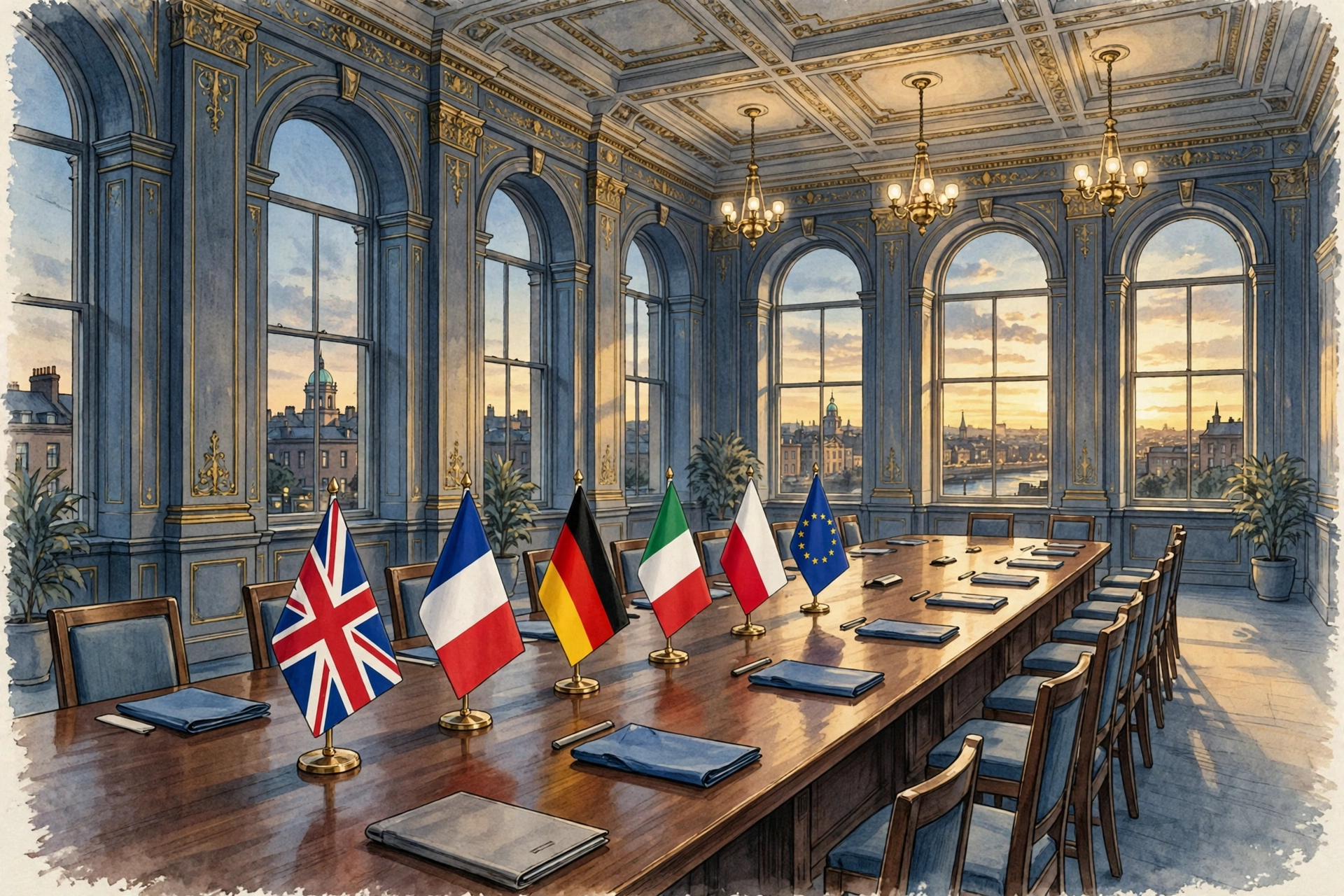
After an informal summit in Dublin on Friday, European Council President António Costa announced that Europe will be represented by the EU institutions — the European Commission and the European Council — together with five countries: the United Kingdom, France, Germany, Italy and Poland.
“Europe must speak with one clear voice and united voice in all discussion that shape the future of Ukraine and the security of our continent. And this is ultimately a team effort,” Costa told a press conference at the end of the meeting, as Reuters reported.
The decision gives institutional form to a European demand for a seat at the table in a diplomatic process driven so far by Washington, Kyiv and Moscow — one that has produced direct contacts among American, Ukrainian and Russian officials but no settlement on territory or a ceasefire.
Who sits on the team
The five countries are Europe’s major military powers: four EU member states plus Britain, which left the bloc but remains part of the Coalition of the Willing, the group of more than 30 countries backing Ukraine and preparing security guarantees for any future ceasefire.
EU officials said the representatives for Europe in future talks were likely to be national security advisers from the five countries, plus delegates from the European Commission and the European Council, the body for EU governments. The team will work with all 27 EU member states and coordinate Europe’s contribution to negotiations alongside Ukraine, the United States and NATO, according to the European Council’s account of the Dublin meeting.
The arrangement is known in diplomatic shorthand as the E5. Its creation does not settle every question of rank and role. EU foreign policy chief Kaja Kallas laid claim to the envoy role on Friday, saying she is the one who represents Europe in foreign and security policy, and that it is not up to Russia to say who should represent the EU.
What the team will — and will not — do
Costa was careful to define the limits of the mandate. The team is not there to negotiate Ukraine’s territory on Kyiv’s behalf.
“This is ultimately a team effort. Only Ukraine has the legitimacy to decide on matters concerning its territory and sovereignty,” Costa said.
A ceasefire remains the stated priority for the Europeans, and the Dublin decision was accompanied by a broader signal of intent. Forty European countries, meeting as a wider group in Dublin on Thursday, signed a declaration saying that any matter affecting European security should be decided with the involvement of Europeans.
The summit itself had been convened around artificial intelligence. Ukraine overshadowed that agenda, a measure of how far the war has come to dominate European diplomacy nearly four years after Russia’s full-scale invasion.
How the decision came about
The agreement follows months of wavering in European capitals over who should speak for the continent, and it comes days after the first direct contacts between the warring sides in months. US envoys Steve Witkoff and Jared Kushner met Vladimir Putin in Moscow on Thursday, then travelled to Dublin to brief Volodymyr Zelenskyy, and said Putin had agreed that Europe would join the next round of talks. That followed the first trilateral talks in nine months in Abu Dhabi on 10 and 11 November.
But the Kremlin has not confirmed that account. Spokesman Dmitry Peskov said on Friday that Moscow must first understand the Europeans’ intentions and readiness to contribute to peace before deciding on talks in an expanded format, and the Russian Foreign Ministry said it was unaware of any such agreement. The Kremlin added that Russia would be open to European countries taking part if it saw they genuinely intended to contribute to peace.
In other words, Europe has now chosen its team — but whether Moscow will admit it to the room is still an open question.
What is still undecided
No date or venue has been announced for the next round of talks, and who exactly will sit in the chairs for the five countries has not been settled. EU leaders are scheduled to return to the question of Ukraine’s financing needs for 2027 and beyond at their next European Council meeting on 26 and 27 November.
The diplomacy is moving on more than one front. Trump, Xi and Putin are due to meet in Shenzhen on 19 November in the first-ever three-way summit of the three leaders, with nuclear arms and Iran expected on the agenda. For Europe, the Dublin decision is the first step towards making sure its voice is heard in whatever follows.
Frequently asked questions
Which countries are in the five-nation team?
The United Kingdom, France, Germany, Italy and Poland, together with the European Commission and the European Council.
Will Europe negotiate Ukraine’s territory?
No. European Council President António Costa said only Ukraine has the legitimacy to decide matters concerning its territory and sovereignty.
When is the next round of talks?
No date or venue has been announced, and the Kremlin has not confirmed that Europe will be admitted to the talks.