D.C. and Virginia Sue to Block Trump’s 250-Foot Triumphal Arch at Memorial Circle
Washington, D.C., and Virginia have gone to federal court together to stop President Donald Trump’s proposed 250-foot Triumphal Arch at Memorial Circle, arguing that the monument cannot be built without approval from Congress and without the environmental and historic reviews the law requires. The 46-page lawsuit, filed on Saturday, October 31, 2026, in the U.S. District Court for the District of Columbia, is now the third legal challenge seeking to halt the project — and it lands just days before a planning commission is due to vote on final approval.
The complaint was brought by District of Columbia Attorney General Brian Schwalb and Virginia Attorney General Jay Jones against the National Park Service, the Interior Department, Interior Secretary Doug Burgum and Park Service comptroller Jessica Bowron. It has been assigned to U.S. District Judge Tanya Chutkan, who is already handling the earlier challenge to the arch.
Timing is at the heart of the dispute: the administration has said construction could begin as early as November 5, when the National Capital Planning Commission considers final plans. The District and Virginia ask the court to declare the approvals unlawful and block construction before then.
What the lawsuit claims
The plaintiffs describe the project as “flagrantly unlawful” without congressional authorization. Federal law governing commemorative works on federal land in the District, they argue, requires specific approval from Congress before a monument of this kind can be built — approval the arch has never received. The complaint also invokes a separate federal statute, 40 U.S.C. 8106, which sets out requirements for construction on federal land in Washington.
The lawsuit further argues that the arch would breach Washington’s Height of Buildings Act, which the plaintiffs say sets a 130-foot limit for much of the District. At 250 feet — about 76 meters, or roughly 100 feet taller than the Statue of Liberty measured from its base to the top of the torch — the arch would be nearly twice that height.
The complaint also challenges how the project was reviewed, saying the Park Service did not begin its historic-preservation review until June 5, 2026, and that environmental and historic reviews were rushed or incomplete. The Commission of Fine Arts gave its final approval on May 21, 2026, and the Park Service has since asked the National Capital Planning Commission for final approval on November 5. The states say the government told the court on October 21 that it could begin construction the same day it receives that approval.
The lawsuit also warns of practical harm: a three-year build at the busy Memorial Circle junction would snarl traffic, produce pollution and stormwater runoff into the Potomac River, and complicate emergency response and evacuation routes.
Why Memorial Circle matters
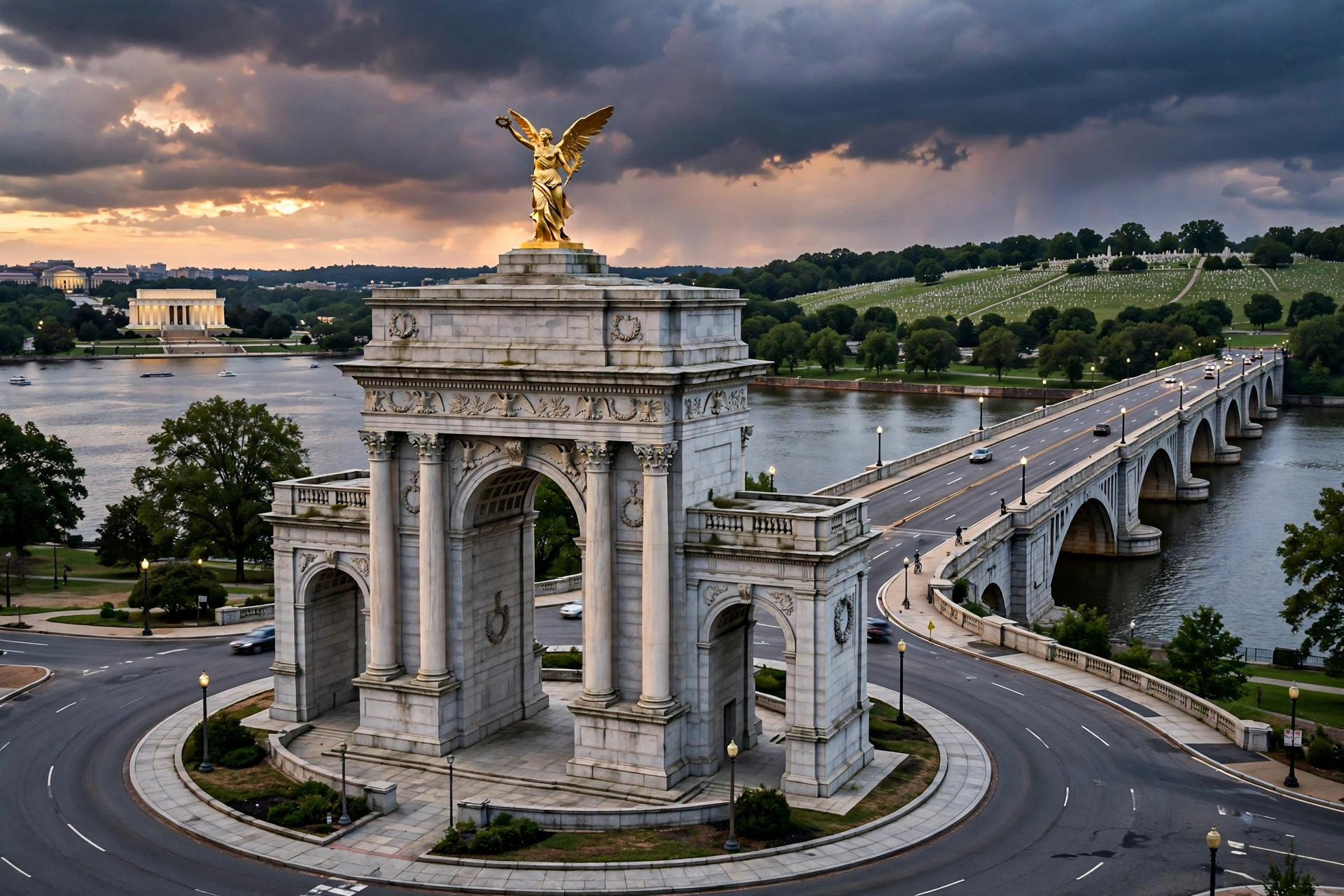
Memorial Circle is no ordinary traffic island. It sits in the Potomac River at the western end of Arlington Memorial Bridge, linking the bridge to Memorial Avenue and Arlington National Cemetery. The bridge was deliberately aligned on the sightline between the Lincoln Memorial and Arlington House, overlooking the cemetery.
That symbolism is central to the first lawsuit, filed in February 2026 by three Vietnam War veterans and a retired architectural historian, who argue the arch would disrupt the view between the Lincoln Memorial and Arlington House and dishonor veterans buried at Arlington. The Associated Press reported that Judge Chutkan has consolidated the cases before her.
Chutkan held a hearing on Friday, October 30, on pausing the project until the original lawsuit is resolved. She did not act immediately, but the Associated Press reported that she said she would move expeditiously — a signal a ruling could come before the November 5 vote.
What the arch would look like
Under plans submitted to the National Capital Planning Commission, the arch would be an approximately 250-foot-tall reinforced concrete structure clad in stone, about 166 feet wide with a 55-foot-wide opening. A central figure would stand above the arch, flanked by two eagles, with views from an observation deck toward area landmarks.
Earlier White House renderings showed a golden, winged figure resembling Lady Liberty holding a torch with an eternal flame, with the phrases “One Nation Under God” and “Liberty and Justice for All” inscribed in gold. The administration presents the arch as a memorial marking the 250th anniversary of American independence, honoring military sacrifice; critics, including the veterans who filed the first lawsuit, have called it a vanity monument.
What happens next
Three steps will decide the arch’s immediate future: Judge Chutkan could pause construction while the lawsuits are litigated; the National Capital Planning Commission votes on final plans on November 5; and, if that approval is granted and no court order intervenes, the government has said work could begin the same day. The District and Virginia are seeking a temporary restraining order and a declaration that the approvals are unlawful.
For now, the arch remains a proposal in renderings, not a construction site. But with a planning vote days away and three lawsuits before a single judge, the fight over Memorial Circle has moved into the courtroom — where the question is no longer whether the arch should be built, but whether it legally can be.
Frequently asked questions
Why are D.C. and Virginia suing over the Triumphal Arch?
They argue it lacks congressional authorization, violates height limits, and skipped proper environmental and historic reviews, and warn that three years of construction would disrupt traffic and emergency access.
How tall would the arch be?
About 250 feet (76 meters), including a statue on top — roughly 100 feet taller than the Statue of Liberty from its base to the top of the torch, and far taller than the 99-foot Lincoln Memorial nearby.
When could construction begin?
The administration has said work could begin as early as November 5, 2026, if the National Capital Planning Commission grants final approval that day — unless a court blocks it first.
What did the judge do at the October 30 hearing?
Judge Tanya Chutkan heard arguments on pausing the project until the first lawsuit is resolved but did not rule immediately, saying she would move expeditiously.
Sources: Associated Press via PBS NewsHour, “Virginia and D.C. sue over Trump’s arch” (pbs.org); District of Columbia v. National Park Service, No. 1:26-cv-03838, complaint filed October 31, 2026, summarized at The Digital Free Press; National Park Service project page (parkplanning.nps.gov); National Capital Planning Commission, New Monumental Arch synopsis for November 5, 2026 (ncpc.gov).