SpaceX Catches Starship From Orbit in Tower-Arms First
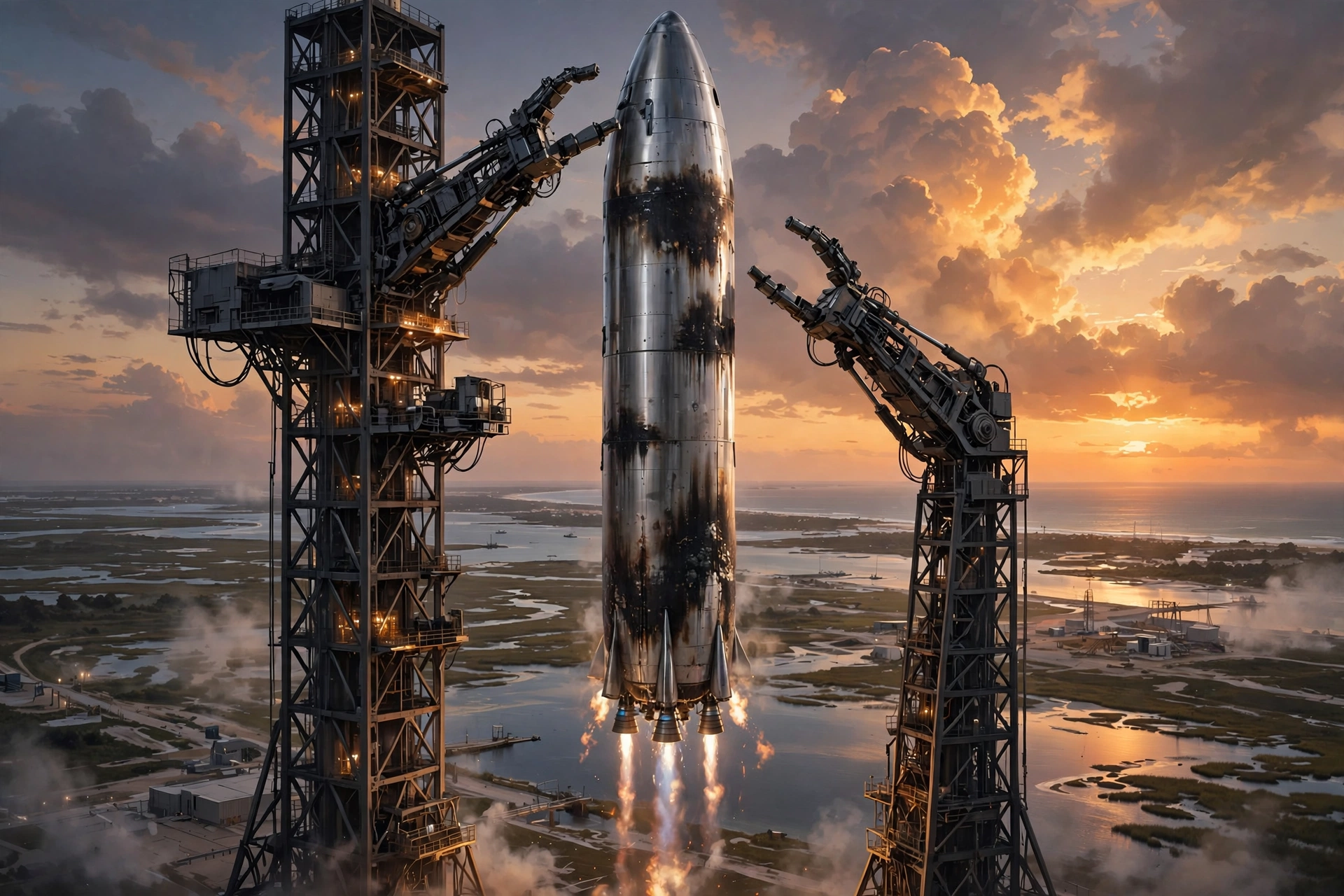
SpaceX has caught the upper stage of its Starship rocket in the giant mechanical arms of its launch tower after almost a full day in orbit, pulling off a recovery that no one had managed before.
The vehicle, known as Ship 42, dropped out of thick cloud over its Starbase site in Texas on Saturday afternoon, relit its engines, swung upright and settled into the tower’s arms, its steel hull blackened by the heat of re-entry. The catch is the second half of a long-promised trick: bringing both parts of the biggest rocket ever built back to the pad they left. Only the first half failed. The Super Heavy booster was lost minutes after lift-off on Friday.
It was the first time a spacecraft returning from orbit has been caught by a launch tower, and it came at the end of the longest Starship flight yet.
A day in orbit, then a catch
Flight 15 lifted off on Friday at 5.47pm Eastern time from Starbase, carrying 26 of SpaceX’s latest Starlink V3 satellites into orbit. Once the payload was away, Ship 42 stayed in space for about 22 and a half hours, circling the Earth 14 times at an altitude of roughly 260 kilometres.
Then came the return. The ship fired one of its Raptor engines to leave orbit and plunged back through the atmosphere at more than 26,000 kilometres per hour, flying east over the Pacific before turning for the Texas coast. Reuters reported that the 52-metre vehicle fell out of thick cloud over the launch site, reignited its engines to flip itself vertical and slowly descended into the tower’s grasp.
Two small fittings near the top of the spacecraft hooked onto the tower’s mechanical arms — nicknamed “chopsticks” and collectively known as Mechazilla — which had closed in to take its weight, leaving it hanging several tens of metres above the ground.
The catch was completed at about 4.20pm Eastern time on Saturday. “We caught a Starship,” SpaceX communications manager Dan Huot said as the company’s marathon livestream ended. Elon Musk, the company’s chief executive, posted photographs from the tower with the caption: “Ship 42 looks great!”
Why the catch matters
SpaceX’s entire case for Starship rests on reuse. Its Falcon 9 rocket already lands its first stage and flies it again, but the second stage — the part that carries payloads into orbit — is thrown away after every launch. Starship is designed to end that waste: both stages return to the tower, are caught, refuelled and flown again.
Musk has said the goal is to “immediately land the rocket and launch it again, just like an airplane.” Catching the upper stage is the missing link in that plan. Until now, the ship had only ever splashed down in the ocean after its test flights. A caught ship can, in theory, be inspected and flown again — and SpaceX has not ruled that out for Ship 42.
The milestone also matters beyond SpaceX. A version of Starship is the vehicle NASA has chosen to land astronauts on the Moon, and its schedule depends on proving that the rocket can be reused quickly and reliably. That work sits alongside the White House’s pledge to return astronauts to the Moon by 2028, a target that needs Starship to move from spectacular tests to routine operations.
The half that did not come home
For all the celebration, Flight 15 was only half a success. The Super Heavy booster, the rocket’s lower half, failed to return to the pad as planned. It was lost about ten minutes after lift-off, after an onboard navigation fault, and crashed into the Gulf of Mexico, where it exploded. SpaceX is still investigating the root cause of the failure.
The company had aimed to recover both parts of the rocket on a single flight for the first time. That double catch remains unachieved. Super Heavy boosters have been caught three times before, most recently in the spring of 2025, so the tower system itself is proven — but doing both halves on the same mission is still to come.
What happens next
Ship 42’s return gives SpaceX something it has never had before: an orbital spacecraft back on the pad intact. Engineers will now inspect the heat-scarred hull to learn how it survived re-entry and whether any of it can fly again.
The next flights will try to repeat the feat — and to add the missing half. Until both stages come home on the same mission, Starship’s promise of a fully reusable rocket remains a demonstration rather than a routine. On Saturday, though, SpaceX proved the harder half of the trick can be done.