SpaceX Starship Reaches Orbit on Flight 15 as Booster Catch Is Aborted
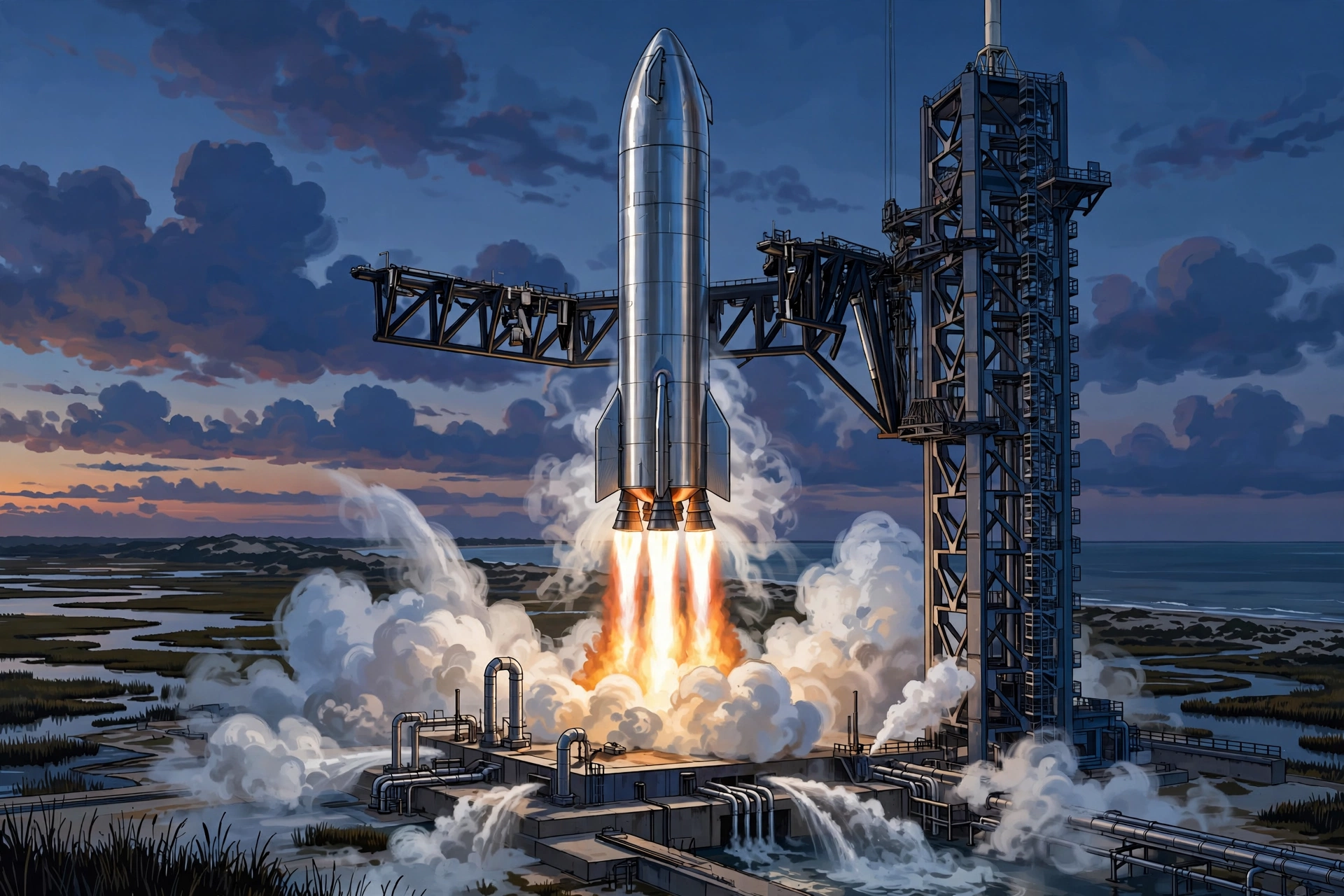
SpaceX’s giant Starship rocket reached orbit for only the second time on Friday, but the boldest part of the test — catching both stages of the vehicle back at its Texas launch site — was only half completed after the Super Heavy booster was diverted into the Gulf of Mexico.
Flight 15 lifted off from SpaceX’s Starbase site on the South Texas coast at 5:47 p.m. ET, powered by 33 Raptor engines burning liquid methane and liquid oxygen. The nearly 400-foot-tall rocket is the largest ever flown, and the Federal Aviation Administration had issued the launch licence only hours earlier, Scientific American reported.
Booster diverted to the Gulf
The two stages separated about two and a half minutes after launch in a manoeuvre known as hot-staging, with the upper stage’s engines already firing as the booster fell away. The booster was meant to flip around, fire its engines to reverse course and fly back to Starbase, where the launch tower’s giant mechanical arms — nicknamed chopsticks — were waiting to catch it.
SpaceX has caught a Super Heavy booster that way before, but on Friday the automated safety criteria for the catch were not met. Flight controllers diverted the booster to a pre-planned point in the Gulf of Mexico, where it splashed down about six and a half minutes after liftoff and broke apart in flames. SpaceX has not said what triggered the abort. Scientific American reported trouble with some of the booster’s engines; Reuters said the reason was not immediately clear.
Second trip to orbit
While the booster headed for the Gulf, Ship 42, the Starship upper stage, kept climbing on its six Raptor engines. A second engine burn about 26 minutes into the flight put it into low Earth orbit at an altitude of about 275 kilometres.
“Starship reached Earth orbit for the second time in history,” SpaceX’s Dan Huot said on the launch broadcast. The first time was Flight 14, on 28 September, which also carried operational satellites.
Shortly after reaching orbit, Ship 42 opened its payload bay and began deploying 26 Starlink V3 satellites, the second batch of operational satellites a Starship has carried. Deployment began about 36 minutes into the flight and was expected to take less than an hour.
Saturday’s catch attempt
Ship 42 is now due to spend about 22 hours in space, circling Earth 14 times, before attempting to return to Starbase at about 4:15 p.m. ET on Saturday. If its systems are healthy, the tower arms will try to catch the ship itself — the first time SpaceX has attempted to recover the upper stage this way.
SpaceX said before launch that it would attempt the catch only if all the systems needed to guide the ship through the atmosphere and into the tower were healthy, so reaching orbit does not guarantee the catch will go ahead. Even a flawless pair of recoveries would leave the bigger prize untested: turning both stages around quickly for another flight.
Why it matters for NASA and the Moon
Starship is central to NASA’s plans to return astronauts to the Moon, and the flight comes as SpaceX reshapes the rest of its business. NPR reported that the company plans to stop flying its workhorse Falcon 9 rocket, which launches the Dragon capsule — currently the only American spacecraft able to ferry NASA astronauts to and from the International Space Station. NASA has contracted three additional station flights, enough to keep Dragon flying through 2028, ahead of the station’s planned retirement in 2030.
The flight also follows Trump’s space proclamation, which pledged a return of American astronauts to the Moon by 2028 and a permanent presence there. SpaceX is also pursuing a $74 billion artificial-intelligence computing push in Texas and Arizona, and reported plans for a SpaceX–Tesla merger surfaced this week.
Frequently Asked Questions
What is Flight 15?
The 15th test flight of SpaceX’s Starship system since 2023, and the second to reach orbit and carry operational satellites.
What happened to the Super Heavy booster?
Its planned tower catch was aborted after the catch criteria were not met. It splashed down in the Gulf of Mexico about six and a half minutes after launch and broke apart.
When does the Starship upper stage come back?
It is due to attempt a tower catch at Starbase at about 4:15 p.m. ET on Saturday, 14 November, after about 22 hours in orbit — if its systems are healthy.