1,156 US Schools Closed Last Year as Enrolment Falls Faster Than Closures
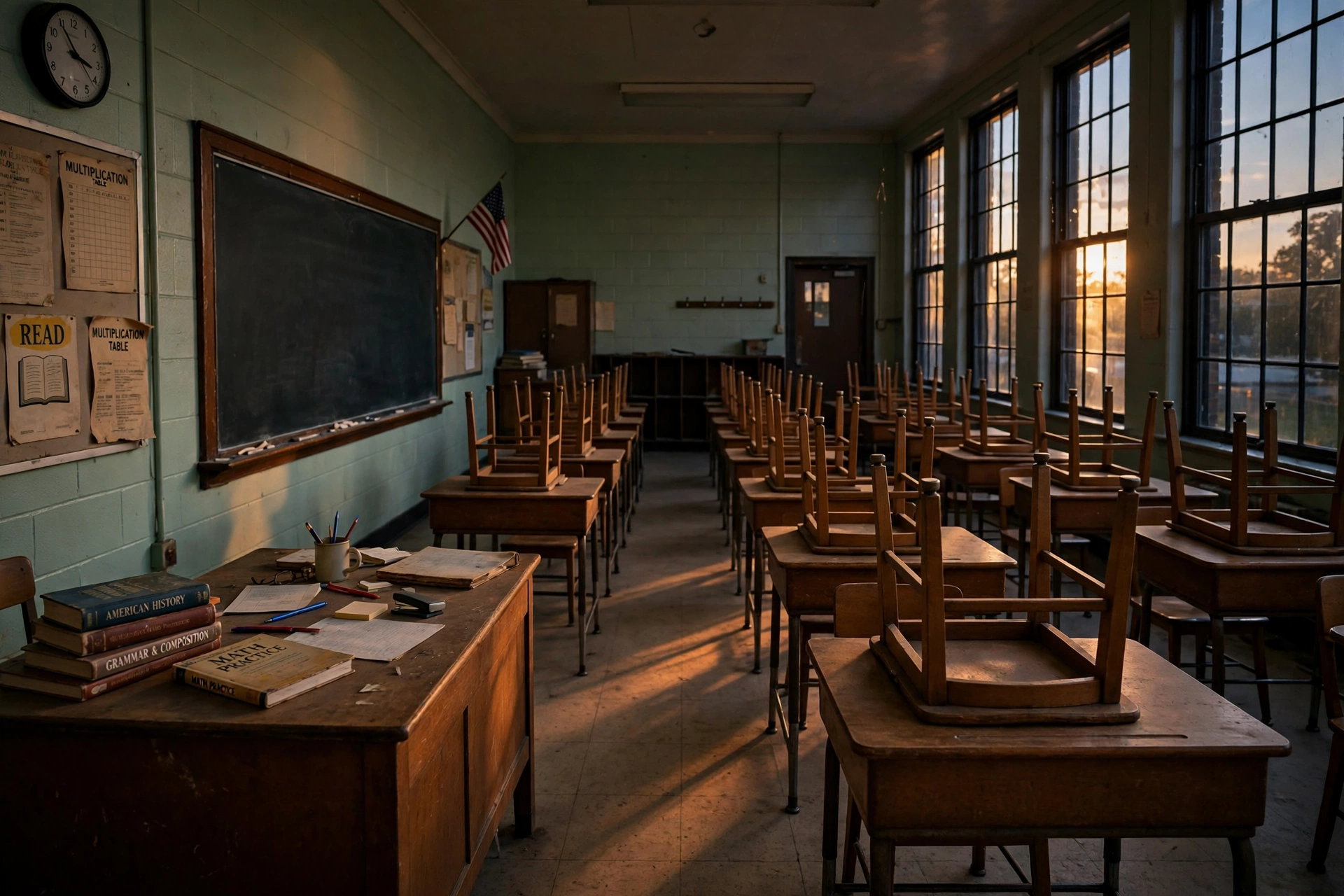
More than 1,150 US public schools shut in the last academic year, the highest number since the pandemic, as pupil numbers fell far faster than districts could close buildings. The closures, counted in an analysis of federal data by Big Local News at Stanford University, reflect a shift education leaders say is now structural: fewer children are entering the system, and the money that follows them is shrinking with it.
Enrolment is falling faster than buildings are closing
Nationwide, public school enrolment fell by more than 1.4 million pupils, roughly 3 per cent, between autumn 2019 and 2024, according to an Associated Press analysis of federal data. National Center for Education Statistics figures show enrolment sliding from about 50.8 million pupils in autumn 2019 to 49.4 million in autumn 2024, a fall of 2.8 per cent, with further declines projected through 2031.
The total number of schools has fallen too, but only to about its pre-pandemic level. Districts are carrying buildings, staff and running costs designed for far more children than they now teach, and each empty seat makes the maths harder.
Vallejo: a district built for twice as many children
Vallejo, California, a working-class city near San Francisco, shows the squeeze clearly. The Vallejo City Unified School District now serves about half as many pupils as it did two decades earlier. Enrolment has tumbled from nearly 18,000 in autumn 2006 to about 9,300, according to the district, and leaders have closed five campuses since 2025 — a quarter of its schools — while cutting up to a third of staff posts to close a $36 million deficit. On average, its schools are only 46 per cent full.
Superintendent Rubén Aurelio does not apologise for the pace. “We’re not just closing schools to close schools,” he said. “We’re right-sizing a district that was built for significantly more kids. And if we’re going to actually improve outcomes for the kids we still have, we need to concentrate resources.”
For families, the arithmetic looks different. Fifth-grader Penny Núñez-Brandão started this year at a new school after her previous one shut, in a class of 32 children. Her teacher resigned in October, and her mother, Kimberly, has already moved an older son to a charter school.
Closures rarely deliver the savings districts expect
Shutting a school is often a false economy. Busing pupils to new schools, paying severance to laid-off staff and securing empty buildings frequently eat up the savings, and displaced pupils often fall behind. Studies from the University of Chicago show displaced students often suffer long-term drops in reading and maths, especially when they end up at lower-performing schools.
“It takes a while to recover, if they recover at all,” said Marisa de la Torre, a managing director of the UChicago Consortium on School Research.
Closures can also set off a downward spiral, as frustrated families leave for charter or private schools, or move away, taking their per-pupil funding with them.
What is driving the decline
Lower birth rates are the primary reason for the fall in enrolment, after a multi-decade slide in the number of children being born. Other forces are at work too: a federal crackdown on immigration, the post-pandemic expansion of private school vouchers and home-schooling, and state and federal education funding that is drying up.
Bellwether and WestEd estimated that declining enrolment could cost schools $11.5 billion in state revenue a year by 2030-31, prompting layoffs, cuts to academic programmes and further closures.
The pressure is not only financial. Google told US schools earlier this month that opting out of its artificial intelligence tools could also cost them access to its search features. School buildings have also closed for shorter, sharper reasons: flooding closed all schools in Brevard County, Florida, for a day earlier this month.
What happens next
Vallejo is not an outlier. Large districts in Cleveland, Houston and Philadelphia are facing similar rounds of closures. Lydia Rainey, research principal at the Center on Reinventing Public Education, cautioned against hoping that birth rates and pupil numbers bounce back.
“That’s extremely wishful thinking,” she said. “States aren’t about to open the coffers and swoop in with additional funds to save schools.”
For districts like Vallejo, the question is no longer whether more schools will close, but how many — and whether the children left behind will be better off in the schools that remain.
Frequently asked questions
How many US public schools closed last year?
A total of 1,156 schools closed during the last academic year, the highest number since the pandemic, according to an analysis of federal data by Big Local News at Stanford University.
How much has US public school enrolment fallen?
Enrolment fell by more than 1.4 million pupils, roughly 3 per cent, between autumn 2019 and 2024, from about 50.8 million to 49.4 million pupils.
Why are districts closing schools?
Falling birth rates are the main driver, alongside tighter state and federal funding, an immigration crackdown, and growth in private school vouchers and home-schooling. Research suggests closures rarely save as much money as districts hope.