Voyager 1 to Cross One Light-Day From Earth on Wednesday
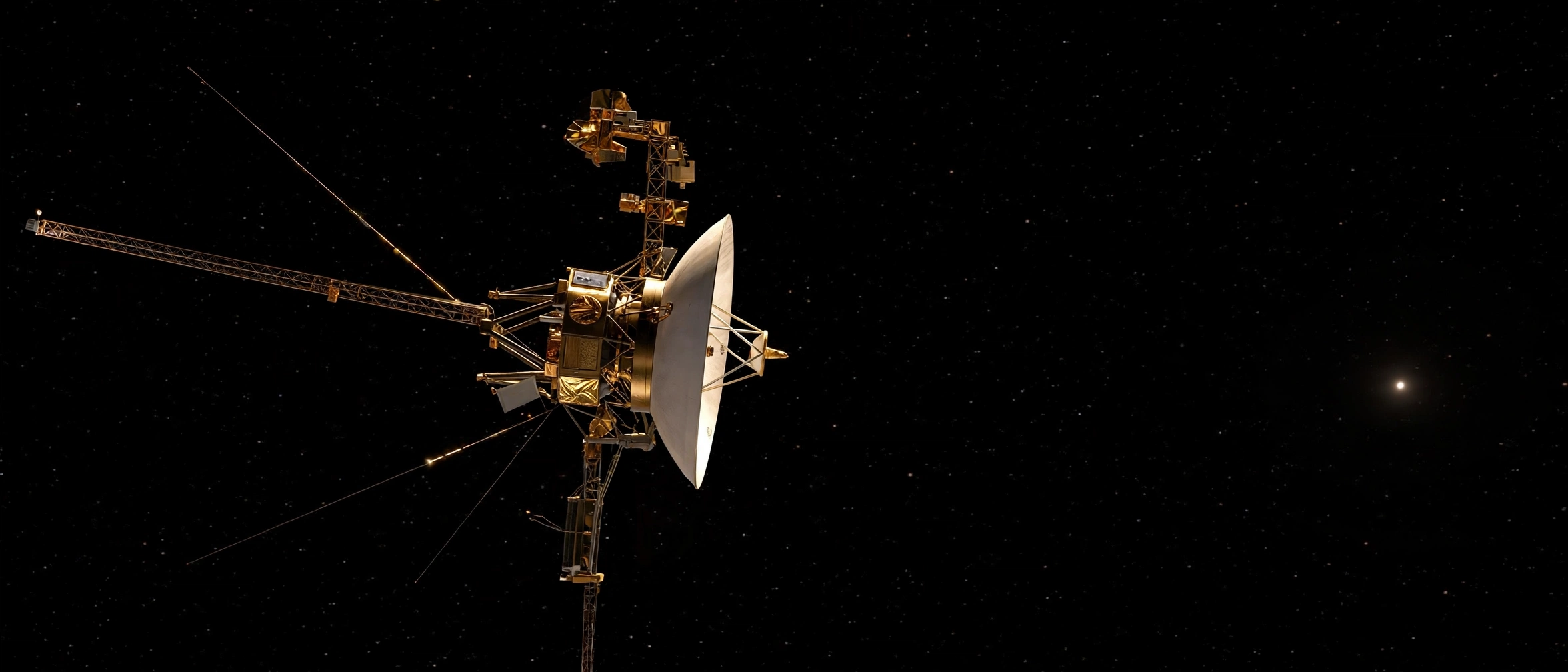
NASA’s Voyager 1 is about to pass a milestone no human-made object has ever reached. On Wednesday, 18 November, the spacecraft will stand one light-day from Earth — so far away that a radio signal travelling at the speed of light will take a full 24 hours to reach it.
According to NASA’s Jet Propulsion Laboratory (JPL), the crossing is expected at 10:16:07 UTC, or 05:16:07 Eastern time. At that moment Voyager 1 will be about 25.902 billion kilometres (16.094 billion miles) from Earth — roughly 173 times the distance between the Earth and the Sun. NASA says the exact moment may shift slightly, because both the spacecraft and the Earth are moving.
It is a cosmic odometer reading rather than a physical boundary. Nothing on the spacecraft will change as it crosses the line. But the number captures, in a single figure, just how far humanity’s most distant explorer has travelled.
A day for a signal to arrive
The practical consequence is already being felt by the small team at JPL in California that still flies the probe. Every exchange with Voyager 1 now takes two days: one day for a command to travel out, and another full day for the spacecraft’s reply to come back.
“If a command does something unexpected, nobody finds out until 48 hours after it was sent,” as one account of the milestone puts it. Engineers must plan each instruction carefully, because there is no quick correction.
The spacecraft’s transmitter puts out only about 23 watts — roughly the power of a refrigerator bulb — yet its signal is still picked up by NASA’s Deep Space Network, the giant antennas that listen for the faintest whispers from deep space. Voyager 1 sends data back at about 160 bits per second, a trickle by modern standards, and each bit arrives carried by only a few hundred photons.
Forty-nine years out
Voyager 1 launched from Cape Canaveral on 5 September 1977, on a mission originally meant to last just a few years. It flew past Jupiter in 1979 and Saturn in 1980, returning the first close-up images of those worlds and their moons, before heading onward into the dark.
In 2012 it crossed the heliopause — the outer boundary of the Sun’s protective bubble — and entered interstellar space, the thin plasma between the stars that the solar wind has never touched. It has been coasting ever since at about 17 kilometres per second, or roughly 61,000 kilometres per hour, heading in the direction of the constellation Ophiuchus.
The spacecraft is now more than four times further from Earth than Pluto’s average distance from the Sun. Its twin, Voyager 2, which entered interstellar space in 2018 on a different trajectory, is about 3.2 billion kilometres closer to home and is not expected to reach one light-day until around November 2035.
How to say hello
NASA is marking the milestone with public events. After sunset on Tuesday, 17 November, the agency is inviting people around the world to join “Shine Bright for Voyager’s Light-Day” by flashing the spacecraft’s call sign, V-G-R, in Morse code with a torch or phone light pointed at the sky. NASA has also published an automated V-G-R flasher for phones and tablets.
On Thursday, 19 November, at 09:00 Pacific time (12:00 Eastern), JPL will host a moderated discussion about the state of both Voyager spacecraft, streamed through NASA Live. The events come ahead of the mission’s 50th launch anniversary in 2027.
What still works aboard Voyager 1
Keeping a 1977 spacecraft alive at such a distance has meant hard choices. Voyager 1 launched with ten science instruments. Its cosmic ray subsystem was switched off in 2025, and its low-energy charged particle instrument was turned off in April 2026, with the option of switching it back on later. Two instruments remain in operation: the magnetometer and the plasma wave instrument.
Power comes from a radioisotope thermoelectric generator, which turns heat from decaying plutonium into electricity. That power supply fades a little every year, and engineers have been switching off heaters and instruments in turn to keep the spacecraft talking for as long as possible.
The milestone arrives at a busy moment for American spaceflight closer to home. NASA is also pressing ahead with plans to return astronauts to the Moon by 2028, and has named eight firms for its $10 billion moon base cargo contract. But no mission has gone further, or lasted longer, than the small probe now a full day’s light from home.
For the engineers who still send it instructions, the routine is now fixed: send the message, then wait a day for it to arrive, and another day to learn whether it worked. Voyager 1 will keep drifting outward, silent and steady, long after the light-day line is behind it.