Gaza Storm Floods 70,000 Tents, Kills Five in Deir al-Balah
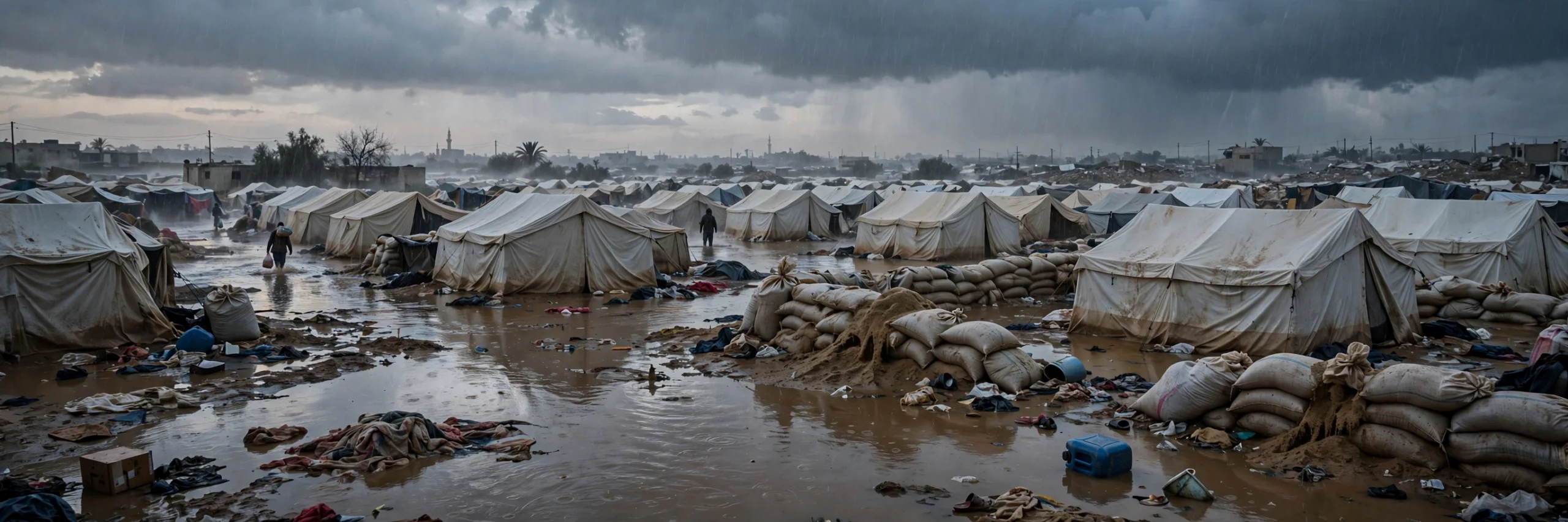
Rain and strong winds have flooded about 70,000 tents sheltering displaced Palestinians across Gaza, killing five people and leaving hundreds of thousands facing the winter with almost no dry shelter.
The storm began late on Friday, 7 November, and within 12 hours water was rising through the canvas of tents in Gaza City, Deir al-Balah, Nuseirat and Khan Younis. Families woke to soaked mattresses, ruined clothing and shelters they could no longer sleep in. Gaza’s civil defence service said it received more than 1,500 emergency calls, and that in some camps the water reached 1.5 metres deep.
The flooding is the first severe test of a fragile ceasefire that has been in effect since 10 October 2025, after two years of war that left most of Gaza’s more than two million residents displaced and living in tent camps. With winter approaching, aid groups say the storm has exposed how little protection those camps offer.
Five killed as embankment collapses in Deir al-Balah
The deadliest single incident came on Sunday in Deir al-Balah, in central Gaza, where a sandstone slab and sandy embankment collapsed onto tents at a displacement camp. A woman and four children were killed, Gaza’s civil defence said, and others were injured.
Mahmud Bassal, a civil defence spokesman, said tents near an elevated soil mound were crushed after the heavy rain weakened the ground. The Associated Press reported that the five victims were among families sheltering at a centre south of the city, and that rescue teams worked through mud and rubble to reach them.
The Government Media Office put initial storm damage at about $3 million.
70,000 tents swamped in 12 hours
On Saturday, the Government Media Office said about 70,000 tents had flooded on the first day of the rain. Hundreds of thousands of displaced people are now sheltering in places the office described as highly vulnerable to further flooding.
Entire displacement camps were swamped, according to civil defence, and families fled in parts of Gaza City and in the central and northern areas of the territory. Some war-damaged houses collapsed, and officials warned more than 2,000 buildings were at risk.
In Khan Younis, in southern Gaza, the municipality warned that more than 900,000 displaced people are concentrated in low-lying areas in the west of the city, with more than 60 locations in the al-Mawasi area at direct risk of flooding. Relief and rescue resources there are severely limited, officials said.
Shelter supplies fall far short
The storm has sharpened a dispute over shelter supplies. The United Nations humanitarian office, OCHA, says Gaza needs about 121,000 tents and 561,000 tarpaulins, and that current supplies cover only about 18 per cent of the need of some 295,000 families.
Al Jazeera reported that only about 20,000 tents have been let into Gaza, while about 200,000 tents and 60,000 mobile homes are blocked at the crossings. Gaza’s health ministry said the flooding had left 350,000 displaced Palestinians sleeping in the open, and its director-general, Munir al-Bursh, appealed for urgent shelter supplies.
Israel’s aid coordination body, COGAT, says it has allowed more than 91,000 tents into Gaza and stepped up sanitation work before the rain. It says broader reconstruction depends on the disarmament of Hamas and strict checks on dual-use items.
Save the Children has warned that more than half a million children are living in critical or catastrophic shelter conditions, many without adequate winter clothing or heating. A United Nations official said almost everyone in the territory needs help.
Winter arrives with nowhere dry to go
The flooding comes as Israel’s government continues to take shape after last month’s election, and as the White House’s decision to phase out US aid to Israel by the end of 2026 reshapes the politics around the war. Neither development has changed the conditions in the camps, where the immediate problem is shelter, not diplomacy.
For families in the camps, the rain has turned an already precarious existence into something worse. Tents that were never built to withstand a storm season are now waterlogged, and aid groups warn that the worst of the season is still ahead. The storm comes in a year when global warming passed the 1.5C limit, a milestone covered in our earlier reporting.
Two years of fighting destroyed homes and infrastructure across Gaza, and the tents that replaced them were always a temporary answer. As this storm shows, that answer is already failing — and most of the supplies needed to fix it are still on the wrong side of the border.
The coming days will show whether more shelter material is allowed in, and whether the ceasefire holds long enough for reconstruction to begin. For now, the families who lost their tents this weekend are sleeping in the open, in the cold, with the rain still falling.