Nasdaq Plunges 5.5% Into Correction as AI Sell-Off Wipes Out Post-Midterm Rally
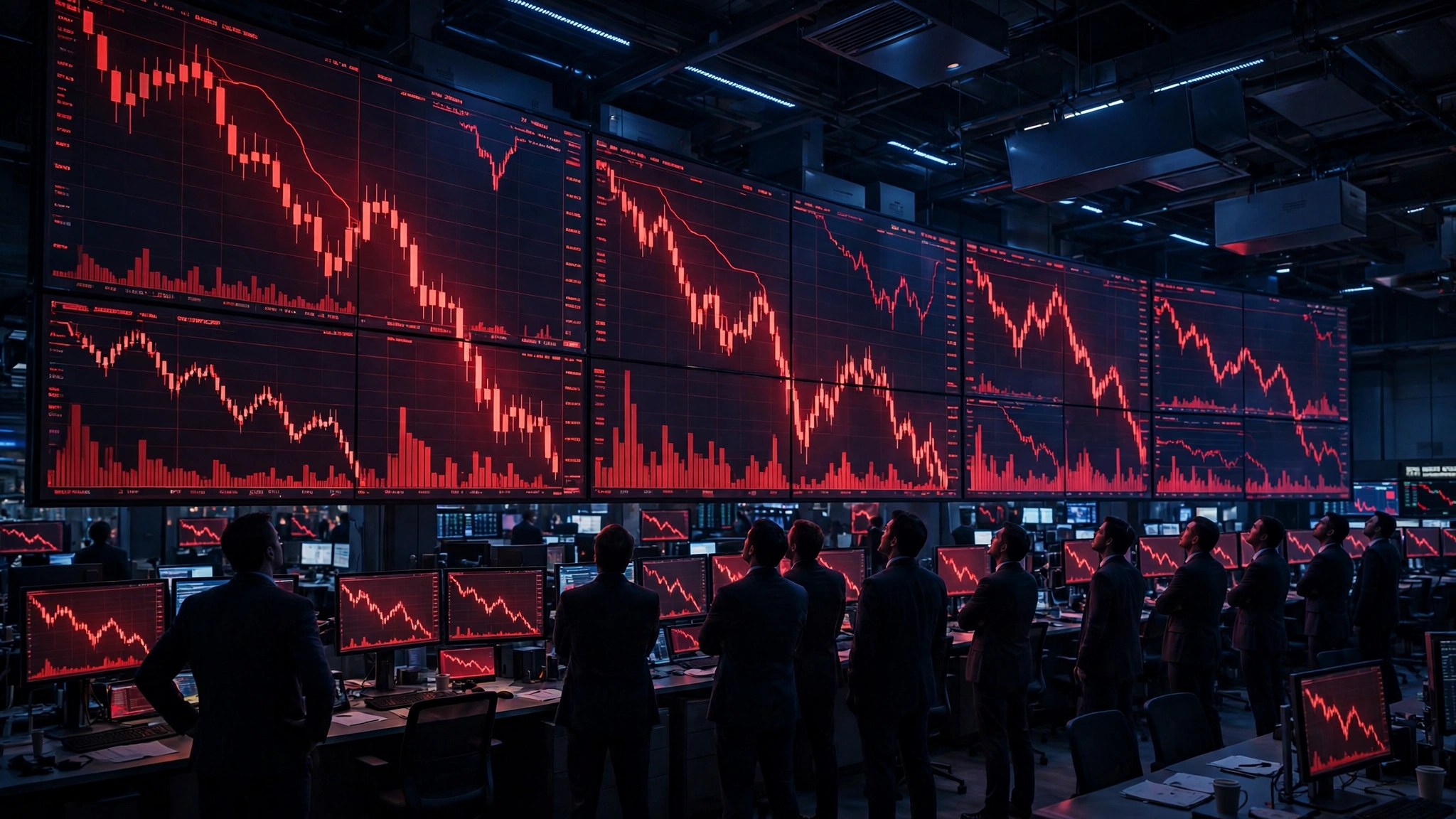
Wall Street suffered its worst day since April 2025 on Thursday, as a brutal sell-off in artificial intelligence and semiconductor shares dragged all three major indexes sharply lower and wiped out the entire post-midterm rally in a single session.
The Nasdaq Composite plunged 5.52% to 24,315.00, a fall of 1,421.52 points that set a record for the index’s largest single-session points loss, according to the Motley Fool. The previous record, a 1,122-point drop, had been set on 5 June 2026. The S&P 500 fell 4.36%, or 334.89 points, to 7,353.73, while the Dow Jones Industrial Average lost 1,833.06 points, or 3.44%, to close at 51,523.06.
All 30 Dow stocks ended the day lower, and all 11 sectors of the S&P 500 finished in the red. The Nasdaq’s fall left it nearly 12% below its record close on 6 October, putting it in correction territory — the term for a fall of more than 10% from a recent peak.
The AI trade comes under pressure
Selling was concentrated in the companies at the heart of the AI boom. The Philadelphia Semiconductor Index, which tracks the largest US chipmakers, slumped 12.2%, and the Nasdaq 100 — home to the biggest technology names — fell 6.4%, erasing about $2.5 trillion in market value in a day, according to Reuters.
Nvidia, the chipmaker most closely associated with the AI boom, fell about 9.3%. Advanced Micro Devices dropped 17.3%, while CoreWeave fell 9.8% and GE Vernova, whose equipment powers data centres, lost 7.5%, according to the Associated Press.
The trigger, analysts said, was the Democratic Party’s sweeping victory in Tuesday’s midterm elections. Investors who had initially celebrated the result as gridlock that would limit new spending quickly began to fear the opposite: that a Democrat-controlled Congress would slow, or even pause, the construction of new AI data centres, impose tighter rules on energy use, and scrutinise the vast sums flowing into AI infrastructure.
Reuters reported that the sell-off reflected fears of more AI scrutiny, particularly over data-centre construction, after the Democratic wins. The Associated Press said the results had raised the prospect of a pause on new data-centre building. No such policy has been enacted — the move reflects what investors fear may happen, not what has happened.
The selling also followed weeks of growing doubt about the returns on AI spending. The Magnificent Seven giants have taken on hundreds of billions of dollars in debt to fund AI infrastructure, and Thursday was the fifth time since mid-October that the Nasdaq has fallen by more than 500 points in a session.
A rally erased in a day
The reversal was underlined by what had happened the day before. On Wednesday, markets had surged after the midterm results, with the Dow gaining 1,569.40 points in what the Associated Press described as the market’s best day in three months. Thursday’s 1,833-point fall gave back all of that gain — and more.
The VIX, Wall Street’s volatility index, jumped from 16.61 on Wednesday to 28.18 on Thursday, a rise of nearly 70%, according to FactSet data. For the week through Thursday, the S&P 500 was down 3%, the Dow 0.5% and the Nasdaq 4.4%, the Associated Press reported.
The rout was not confined to equities. Brent crude has also fallen sharply this week, dropping below $100 a barrel as the midterm result rewrote bets on the Iran conflict.
Asia follows Wall Street lower
The sell-off spread across Asia when markets opened on Friday. Japan’s Nikkei 225 fell more than 7% in morning trading, dropping below 60,000 for the first time since May, before closing down 5.99% at 57,420.23 — a level that put it in bear-market territory, more than 20% below its June peak.
In Tokyo, Rohm tumbled about 20%, Furukawa Electric lost more than 19%, Resonac fell roughly 15% and Kioxia dropped more than 12%, while SoftBank Group declined 11%, according to the Japan Times.
South Korea’s Kospi fell more than 8% at one point, triggering a circuit breaker, before closing about 7% lower. SK Hynix tumbled 12% and Samsung Electronics shed 10%. Taiwan’s market fell more than 8%, and Hong Kong’s Hang Seng AI Index dropped about 7%.
What comes next
Attention now turns to Friday’s US jobs report, the first hard labour-market data since the election. The October nonfarm payrolls figures, due at 13:30 GMT, will be watched for signs of whether the economy is cooling — and for clues about how the Federal Reserve might respond.
Analysts cautioned against reading Thursday as the end of the AI boom. Saxo strategist Charu Chanana told Reuters that technological leadership remained a priority for both parties, while AMP chief economist Shane Oliver said richly valued technology shares had been vulnerable to a correction even before the vote.


[…] will read the report against a nervous market backdrop. The Nasdaq slid into correction territory on Thursday as chip stocks led a sharp sell-off, with traders weighing both the midterm results and […]
[…] report lands a day after Wall Street’s worst sell-off since April, when the Nasdaq plunged 5.5% into correction territory as AI and chip shares tumbled. The strong jobs figures give the Federal […]
[…] immediate cause was the collapse in US technology shares on Thursday. The Nasdaq fell 5.5% on Thursday, its worst day since April 2025, while the Philadelphia Semiconductor Index plunged 12.24%. Nvidia […]
[…] rebound won back only a fraction of Thursday’s losses. The Nasdaq had plunged 5.5% in the previous session, its steepest one-day fall in 19 months, confirming it had entered correction territory after […]
[…] timing could hardly be worse. The Nasdaq plunged 5.5% on Thursday into correction territory as investors dumped AI shares, wiping out the post-midterm rally. […]
[…] report also arrived at the end of a bruising week for markets. The Nasdaq’s slide into correction territory on Thursday rattled investors before stocks bounced back on Friday, and investors balked at Anthropic’s […]
[…] Nvidia’s market value, one of the largest single-day losses of value by any listed company. The Nasdaq suffered its largest daily decline since the 2020 pandemic in the same session, two days after the midterm […]