Third US Aircraft Carrier Reaches Middle East as Iran Warns It Will Not Wait
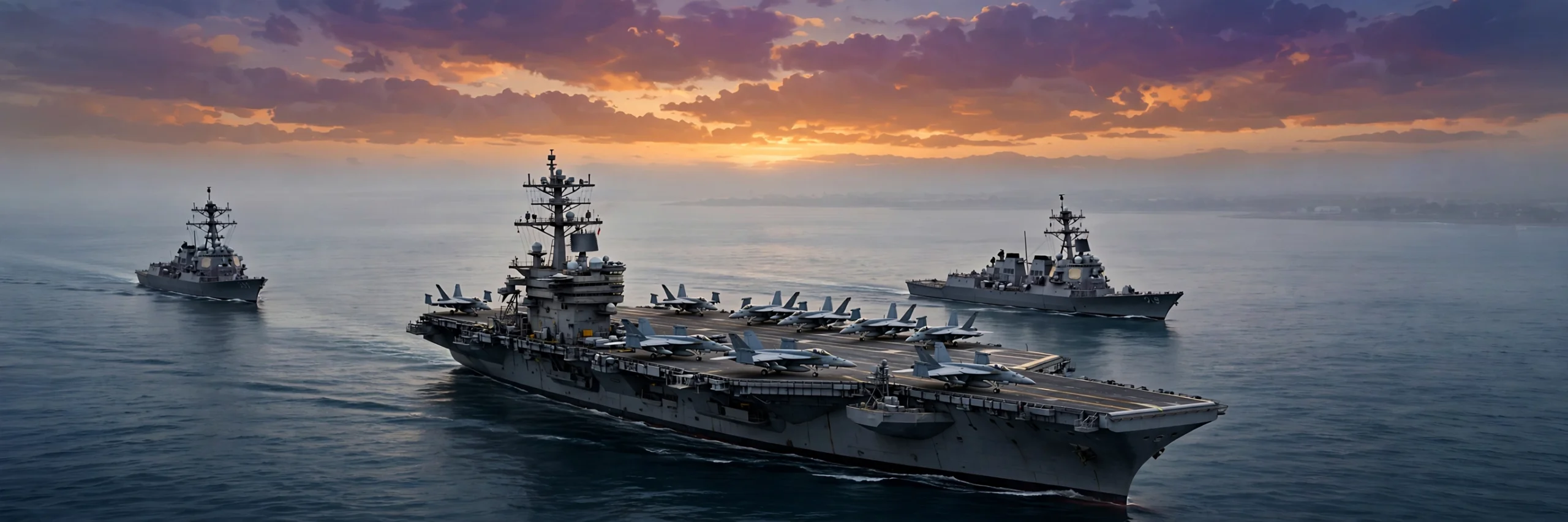
The USS Theodore Roosevelt has entered US Central Command’s area of responsibility, giving the United States three aircraft carrier strike groups in the Middle East for the first time since April, US officials said.
The nuclear-powered carrier arrived on Sunday 15 November, according to a US official who spoke to ABC News, and was separately confirmed to Al Jazeera on Monday. It joins the USS George H.W. Bush and the USS George Washington, which are already operating in the Arabian Sea. Neither the Pentagon nor Central Command has formally confirmed the deployment.
The arrival is the largest American naval concentration in the region since the spring, and it comes as diplomatic efforts to end the US-Iran war and reopen the Strait of Hormuz remain stalled.
Three carriers, more than 20 warships
The three strike groups are part of a force of more than 20 Navy vessels supporting the US blockade of Iranian ports, ABC News reported, citing a US official. The wider flotilla in the Arabian Sea includes 13 destroyers, two cruisers and a littoral combat ship, with more than 20,000 sailors and Marines, according to the US Navy.
The Bush arrived in April and the Washington in August. The Roosevelt left its home port of San Diego in September, departed Singapore in early November and sailed through the Strait of Malacca toward the Indian Ocean. Central Command later posted on X that the ship was under way in the Indian Ocean, writing: “USS Theodore Roosevelt (CVN 71) is underway in the Indian Ocean.”
The blockade began on 13 April, after nuclear negotiations between Washington and Tehran collapsed. The war itself began on 28 February, when the United States and Israel launched joint strikes on Iran over its nuclear programme. Al Jazeera reported that the Makin Island Amphibious Ready Group, carrying more than 2,000 Marines, has also moved toward the region.
Arrival came on the day of a drone attack on Bahrain
The carrier arrived on the same day that Iran’s Islamic Revolutionary Guard Corps said it had launched six drones at a US radar system in Bahrain. The Guard said the drones targeted an American early-warning radar at the Al-Riffa helicopter base, south of the capital Manama, and warned that any US attack would draw a more severe response.
It was the second such attack in three days. On Friday 13 November, US forces intercepted two Iranian drones headed toward Bahrain. Bahrain’s military said its air defences had stopped Sunday’s drones before they reached their targets, and the US ambassador to Bahrain, Stephanie Hallett, said the Guard’s claims were false, that all the drones were intercepted and that there were no injuries or damage. Central Command had not commented on Sunday’s claim, Al Jazeera reported.
Bahrain hosts the headquarters of the US Navy’s Fifth Fleet. The US Embassy in Manama issued a security alert on 15 November, warning residents of possible flight cancellations, airspace closures and travel disruption.
Tehran warns it will not wait
Iran’s deputy foreign minister, Kazem Gharibabadi, said late on Sunday that Tehran “will not wait for the US to attack first”. He told Iranian state television that Tehran was preparing for three scenarios: diplomacy, economic blockade and military aggression.
Iran says it remains in a state of war and wants the blockade lifted. Its listed conditions for reopening the Strait of Hormuz include ending the US naval blockade, lifting sanctions, releasing frozen funds, stopping the fighting on all fronts and a formal end to the war, according to Al Jazeera.
The Guard’s navy has separately claimed that oil tankers struck sea mines in the strait, with further claims of sinkings on Monday. None of those claims has been independently verified, and reports of fresh American strikes on southern Iran are also unconfirmed.
How long will all three stay?
It is not yet clear whether the Roosevelt is an addition or a relief. The carrier had been expected to replace the George Washington, which has been in the region since August. A US military official told CBS News that the three-carrier presence was expected to be temporary as strike groups rotate, though American officials said all three could stay if necessary.
President Donald Trump has said new strikes are “quite unlikely” while keeping the option open, after meeting Qatar’s prime minister last week. Qatar has circulated a two-day plan aimed at reopening the Strait of Hormuz, and Pakistan has said a US reply to Iran’s version of the plan is still pending.
What happens next may turn on the diplomacy due this week. Mr Trump is travelling to Asia for a planned trilateral meeting with China’s Xi Jinping and Russia’s Vladimir Putin in Shenzhen on Thursday 19 November, where the war and the blockade are expected to feature. Until then, the immediate picture is a much heavier American naval presence in the Gulf, an Iranian government warning that it may act first, and talks that remain stuck.