SS United States Lands Upright on Gulf Floor as First Divers Visit World’s Largest Reef
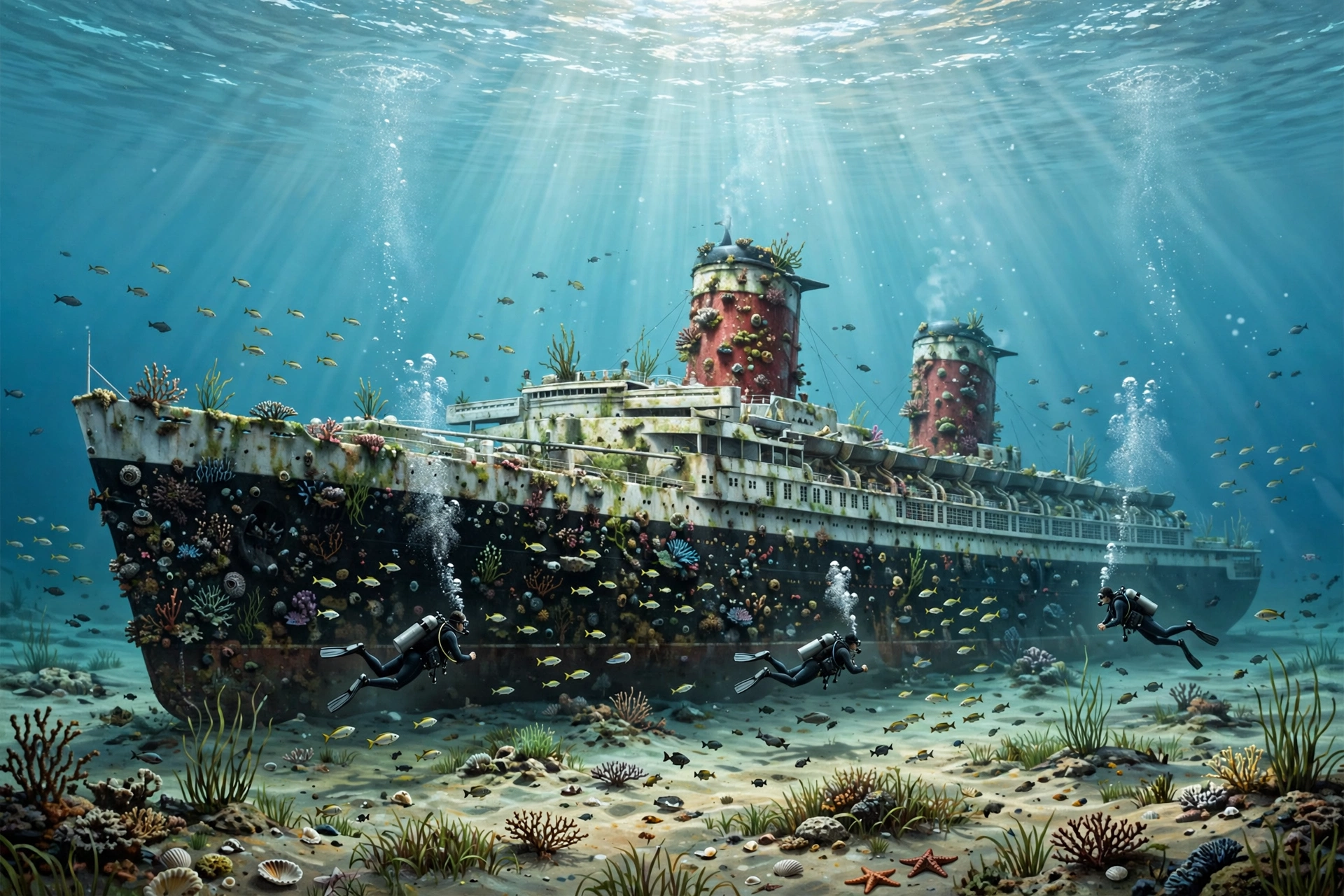
The SS United States has completed her final voyage — and she is sitting upright. The 990-foot ocean liner disappeared beneath the Gulf of Mexico just before 10 p.m. Eastern time on Wednesday, 11 November, and by Thursday, Okaloosa County confirmed that sonar and a remotely operated vehicle had found her resting upright on the seabed about 22 nautical miles southwest of Destin-Fort Walton Beach, Florida. The county has lifted the safety zone around the site, and the first divers to reach the wreck have photographed her sitting upright, turning the fastest ocean liner in history into the world’s largest artificial reef.
An upright landing, confirmed
The confirmation mattered. The ship listed heavily to port in her final minutes on the livestream of the sinking, and officials had aimed for an upright landing so that divers could reach her upper decks. County spokesman Nick Tomecek confirmed on Thursday that sonar and a remotely operated vehicle showed the ship had landed upright, as intended, the Pensacola News Journal reported.
The first divers down, Will Hinton and Rustin Cassway, have since photographed her sitting upright on the sand. The county lifted the safety zone on Thursday, opening the site to divers, although rough seas had delayed the first inspection earlier in the day. Final surveyed depths have not yet been published, and the figures released so far are the plan rather than a survey: the seabed at the site sits at around 180 feet, with the top of the ship expected about 55 to 60 feet below the surface — within reach of recreational divers, while the hull and the sand at the bottom are a job for technical divers.
The sinking was brought forward by a day, we reported ahead of the sinking, after Okaloosa County moved the deployment from Thursday, 12 November, because of strong winds forecast for that day. The public send-off ceremony planned for Wednesday afternoon was cancelled, and the deployment began in the early afternoon instead. The date fell on Veterans Day, a coincidence county officials acknowledged when they announced the change.
A record that still stands
The SS United States was the pride of American shipbuilding. On her maiden voyage in 1952 she crossed the Atlantic in 3 days and 10 hours, a transatlantic speed record for a passenger liner that still stands. She was designed by William Francis Gibbs to be converted into a high-speed troop transport if the need arose, and her hull was divided into 20 watertight compartments.
She was retired in 1969 and spent decades laid up, docked in Philadelphia from 1996 until February 2025. Okaloosa County bought her for $1 million in 2024, rescuing her from the scrapyard with a $13.5 million plan to turn her into a reef. She was towed to Mobile, Alabama, for preparation, and left Mobile under tow on Monday, 9 November, for her final journey to the deployment site.
Rather than using explosives, engineers sank her by controlled flooding, opening her compartments in a planned sequence so that she would settle upright on the seabed.
What divers will find
The reef sits at 30° 07.148′ N, 86° 46.755′ W, on the west side of Okaloosa County’s Large Area Artificial Reef Site, about 22 nautical miles southwest of Destin and 32 nautical miles southeast of Pensacola. At 990 feet long, she takes the title of world’s largest artificial reef from the 888-foot aircraft carrier USS Oriskany, deliberately sunk off Pensacola in 2006.
She joins a network of more than 500 artificial reef sites off Destin-Fort Walton Beach, and researchers at the Woods Hole Oceanographic Institution have announced a multi-year study of how marine organisms colonise the wreck and how underwater ecosystems develop around it. Her funnels, radar mast and bow anchor are to be displayed in a future museum on land.
For Florida’s Gulf coast, the reef is also a new draw for dive tourism. The county expects the upper decks to be reachable by recreational divers once survey work is complete, while deeper sections will remain the preserve of technical divers with the training and gas to reach them. The final coordinates and surveyed depths will be passed to the U.S. Army Corps of Engineers once the survey teams have finished their work.
Seventy-four years after she set the Atlantic alight, the SS United States has found a second life — not racing across the ocean, but resting beneath it, already drawing the first visitors to her new home on the Gulf floor.