Asteroid Bennu’s Amino Acids Point to Unexpected Origins for Life’s Building Blocks
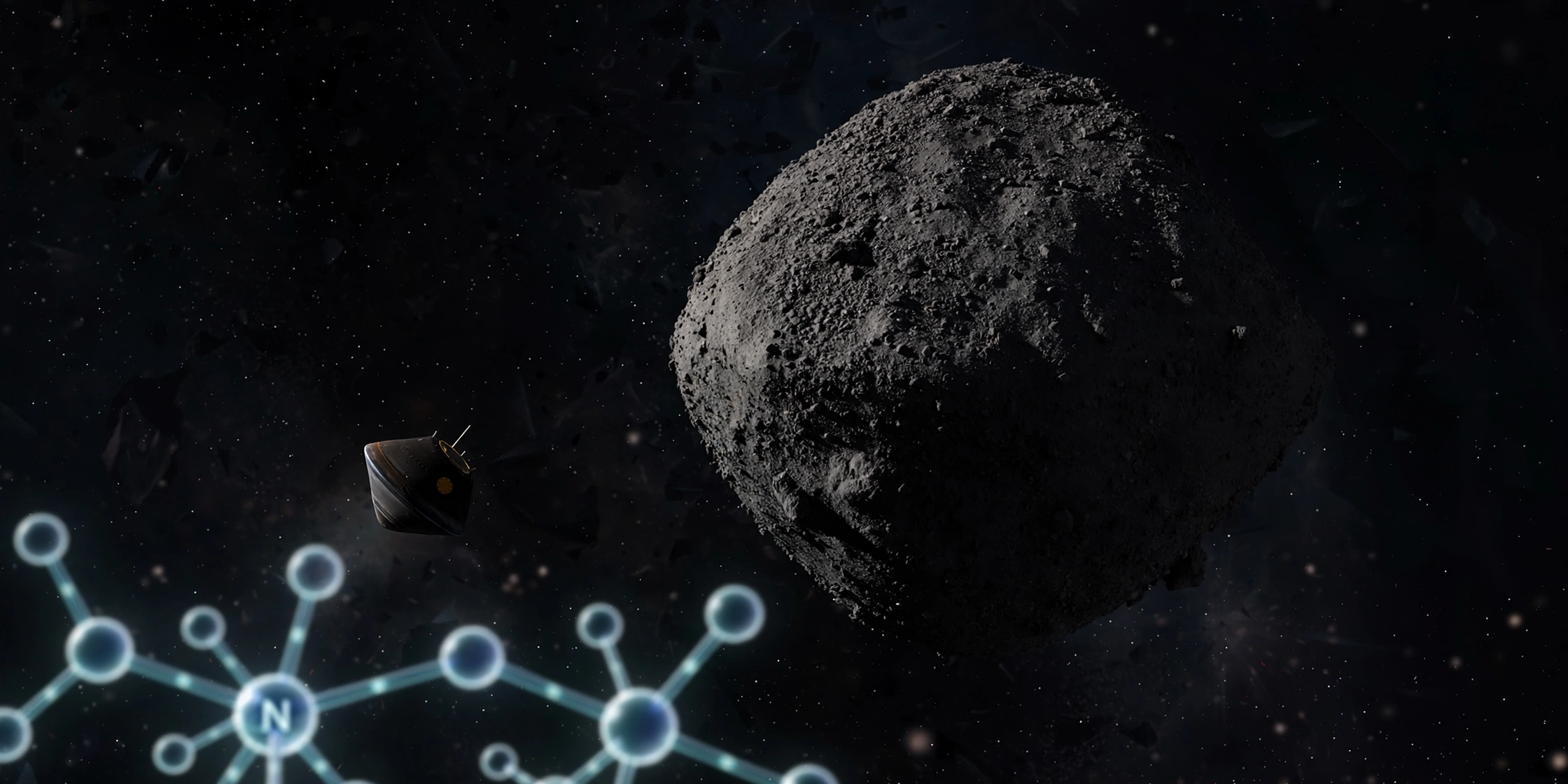
Amino acids carried to Earth by NASA’s OSIRIS-REx mission are telling a stranger story than scientists expected. New analysis of material from asteroid Bennu shows that molecules essential to life may have formed in different parts of the early solar system — and through processes that challenge long-held ideas about where life’s building blocks come from.
The research, published in Communications Earth & Environment and reported this week by Phys.org, compared beta-alanine, an amino acid found in samples from Bennu and from the Murchison meteorite, which fell to Earth in 1969. The Bennu sample was delivered in 2023 by NASA’s OSIRIS-REx spacecraft, giving scientists pristine material untouched by Earth’s environment. Bennu itself is now more than 200 million miles (322 million kilometres) from Earth.
“Amino acids are the building blocks of proteins and peptides, but they are also found in carbon-rich meteorites and asteroid samples, so they can provide a direct link between space chemistry and the origins of life on Earth,” said lead author Ophélie Mcintosh, a former postdoctoral researcher in Penn State’s Department of Geosciences.
A fingerprint inside the molecule
Most studies of amino acids in space samples measure how much of each molecule is present, or take an average of the isotopes — slight variations in the mass of a molecule’s atoms — across the whole molecule. The Penn State team, led by Mcintosh with professor Christopher House and principal investigator Katherine Freeman, developed a new approach that measures the isotopes at each position inside the molecule.
“Isotope ratios provide a measurable tag that can link molecules to specific reservoirs or processes,” said House. “For our study, isotopes provided clues to an older history for specific atoms in a molecule.”
Two instruments made the work possible: the pico-CSIA, which exists only at Penn State and can measure isotopic averages from extremely small amounts of material, and a modified GC-Orbitrap that measures isotope composition at different positions within the molecule. The combination matters because samples returned from Bennu are rare and tiny.
Same average, different story
When the team compared beta-alanine from Bennu with beta-alanine from Murchison, the averages looked almost identical. “When you compare the Bennu and Murchison samples, the carbon isotope average is so close that when you factor in margin of error, they’re basically the same,” Mcintosh said. “But when you look at intramolecular carbon, they’re completely different.”
Beta-alanine has three carbon atoms. In both samples, one of the three measured much higher in neutrons — the subatomic particles that distinguish isotopes — while the other two were very depleted. But the specific values were distinctly different between the two samples. The enriched carbon in the Bennu sample measured as the largest intramolecular carbon isotope anomaly yet reported in an organic molecule from an asteroid or meteorite sample.
“I was genuinely astonished by the enormous isotope difference between two neighboring atom positions within the same molecule,” said Freeman, Evan Pugh University Professor of Geosciences at Penn State. “The preservation of such startling differences is an indicator of the primordial nature of these molecules. We are working with molecules formed at the very dawn of the solar system, possibly even before the formation of Earth.”
The overall pattern of isotopes within the molecule was similar in both samples, suggesting the two may share a related underlying chemistry and could have formed through the same process. But the different measurements indicate they were formed in different parts of the solar system — a finding that widens the range of environments where life’s building blocks can form.
A cold birthplace for life’s building blocks
The beta-alanine result follows earlier work by the same group on glycine, the simplest and most abundant amino acid. That study found glycine on Bennu may have formed in a harsh, cold environment — which goes against the prevailing idea that the building blocks of life formed under warm and wet conditions.
Beta-alanine is not one of the 20 amino acids that form proteins, but it is naturally produced in the human body and can combine with other amino acids to make peptides that can act as molecular enzymes. It is also one of the most abundant amino acids found in asteroid and meteorite samples, making it a useful window into prebiotic chemistry.
“One of the main things we discovered, for both glycine and beta-alanine, is that they might have formed in different environments or places in the solar system,” Mcintosh said. “This broadens our understanding of the type of environments where you can form those very important molecules for prebiotic chemistry.”
What comes next
The OSIRIS-REx mission has concluded, but analysis of the Bennu samples continues. Freeman said an important next step is to study how space environments and processes — such as exposure to water — might affect the order of isotopes within molecules. Mcintosh hopes the intramolecular isotope technique will be used more widely in astronomy and beyond.
The Bennu work comes in a busy year for space science, from NASA’s Moon base cargo contracts and a promised Moon return by 2028 to the discovery of the oldest quasar pair ever found — a reminder that the early solar system and the early universe alike are still full of surprises.
Frequently asked questions
What is beta-alanine?
Beta-alanine is an amino acid that is not one of the 20 used to build proteins, but it occurs naturally in the human body and is one of the most abundant amino acids found in asteroid and meteorite samples.
Why does the Bennu sample matter?
NASA’s OSIRIS-REx mission delivered the Bennu sample to Earth in 2023. Because it came directly from space, it is free of the terrestrial contamination that affects meteorites that land on Earth.
Does this prove life came from space?
No. The study shows that amino acids — the building blocks of proteins — can form in different parts of the early solar system. It does not show that life itself began in space.