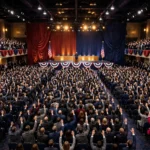
ASEAN Summit Opens in Manila as Leaders Face Trade Strains and Security Tests

Southeast Asian leaders opened the 49th ASEAN Summit in Manila on Sunday, beginning three days of talks against a backdrop of trade uncertainty, rising energy costs and unresolved security disputes.
Philippine President Ferdinand Marcos Jr declared the summit open at the Philippine International Convention Center in Pasay City. The Philippines is chairing the 11-member Association of Southeast Asian Nations this year, under the theme “Navigating Our Future, Together”, and will hand the rotating chairmanship to Singapore at the close of the meetings on Tuesday.
In his opening address, Marcos said geopolitical tensions, economic uncertainty, new technologies, climate change and transnational threats were reshaping the region faster than any one country could respond to alone.
Trade pressures at the top of the agenda
Trade looms large over the gathering. United States imports of goods from ASEAN reached $453.6 billion in 2025, an increase of 29.2 per cent on the previous year, and leaders are under pressure to keep the region’s export-driven economies growing as tariff and supply-chain uncertainty persists.
A day before the summit opened, ASEAN ministers signed a digital economy framework agreement in Manila. The pact is intended to harmonise rules for digital trade across the bloc, although full conclusion and signing remain planned for 2027 — a reminder that the opening marks the start of the leaders’ gathering, not the announcement of finished deals.
South China Sea and Myanmar in focus
The long-running South China Sea dispute and the crisis in Myanmar sit high on the agenda. Leaders are expected to review progress on a code of conduct for the South China Sea and to assess how the bloc’s Five-Point Consensus on Myanmar has been carried out, with the country’s civil conflict now in its sixth year.
The summit comes as the Middle East war pushes up energy costs across the region, a pressure point for several ASEAN economies that import most of their fuel. Cross-border pollution and the conflict’s wider effects are also expected to be discussed, according to regional reporting.
Trump, the Quad and a crowded Manila
The programme extends well beyond talks among ASEAN members. Partner meetings are scheduled for Monday and Tuesday, drawing leaders from the United States, China, Japan, India, South Korea, Australia, Canada and the United Nations.
Donald Trump is expected in Manila on Tuesday, the final day of the summit, for meetings with ASEAN leaders and a summit of the Quad security grouping, which brings together the United States, Japan, Australia and India. China is expected to be represented by Premier Li Qiang, Japan by Prime Minister Sanae Takaichi and India by Prime Minister Narendra Modi. The Manila stop is part of Trump’s wider Asia trip, which continues to the Shenzhen summit, where a trilateral meeting with Xi Jinping and Vladimir Putin is expected.
United Nations Secretary-General António Guterres arrived on Saturday and is due to attend the opening ceremony and the ASEAN-UN summit on Monday. Brazilian President Luiz Inácio Lula da Silva, who arrived on Friday for a state visit, will join Sunday’s plenary as a guest of the chair, as Brazil seeks full dialogue-partner status.
The gathering is one of the largest diplomatic events Manila has hosted in years. More than 19,000 police and military personnel have been deployed for security, and the Philippine government has declared 16 to 18 November special non-working days in Metro Manila.
A chairship shaped by crisis
The Philippines was not originally scheduled to chair ASEAN this year. It took over the role after Myanmar formally relinquished its turn amid its internal crisis and regional diplomatic pressure. This year is also the first in which Timor-Leste takes part as the bloc’s eleventh member.
For Marcos, the summit is a chance to show that ASEAN can still act together despite its divisions. Whether the next two days produce concrete agreements — on the South China Sea, on Myanmar, or on trade — will be the test of that claim.