G7 Demands Full Ukraine Ceasefire and Warns Iran Over Hormuz Shipping
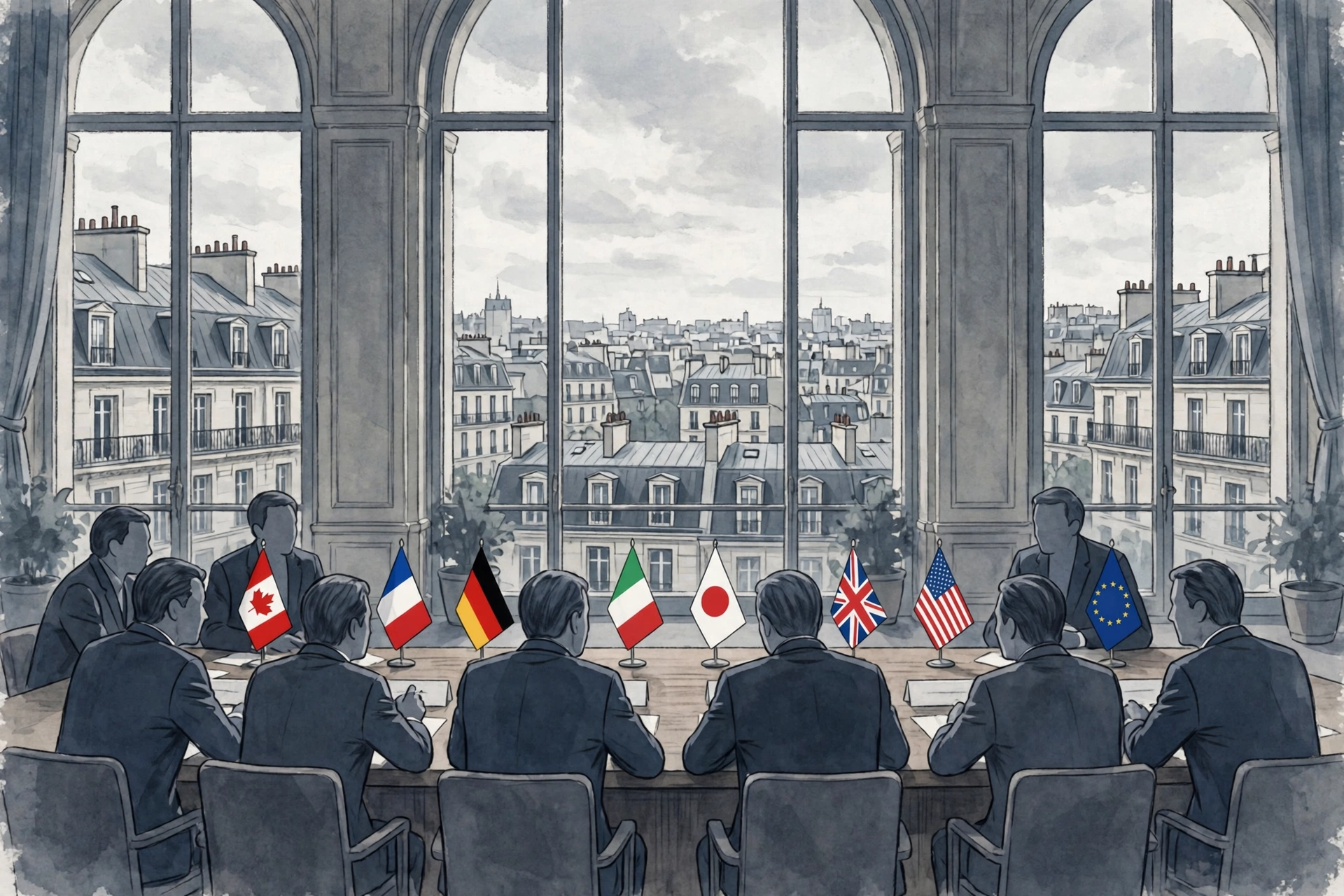
Foreign ministers from the world’s leading democracies have issued a joint declaration demanding a full ceasefire in Ukraine and warning Iran to stop attacking shipping in the Strait of Hormuz, after two days of talks in Paris.
The statement, published on Wednesday 11 November, followed a meeting of the G7 foreign ministers — from Canada, France, Germany, Italy, Japan, the United Kingdom and the United States, joined by the European Union’s High Representative — held in Paris on 9 and 10 November under France’s presidency of the group. The British government published the same text.
A full ceasefire in Ukraine
On Ukraine, the ministers reaffirmed what they called their “unwavering support” for the country and its people as they defend their territorial integrity, sovereignty, freedom and independence.
They reiterated their support for US-led efforts to reach peace through direct negotiations and stressed the importance of securing “a full, comprehensive, and reciprocal ceasefire”. A reciprocal halt to attacks on all energy infrastructure and in the Black Sea, they said, would be an important first step towards a just and lasting peace — protecting civilians and reducing disruption to heating, water and food supplies.
The ministers also took stock of progress on supplying Ukraine with air defence systems and interceptors, and pledged to step up financial and material support to help the country get through the winter, while acknowledging its pressing financing needs for 2027 and beyond.
Pressure on Russia’s war economy was a central theme. The ministers condemned the provision of military assistance to Russia by North Korea and Iran, and the supply of weapons, military training and dual-use components by China, saying it enables the war to continue. They said they intended to keep taking action against those countries, and reaffirmed their commitment to coordinate closely on sanctions, including action against the so-called shadow fleet of ships used to evade restrictions.
Warning to Iran over Hormuz
The declaration’s sharpest language on the Middle East was directed at Iran. The ministers said Iran must never be allowed to develop or acquire a nuclear weapon, and urged Tehran to stop supporting non-state armed groups in the region. Without a diplomatic solution, they committed to continuing their coordination “to economically and politically constrain the Iranian regime’s ability to sow instability in the region and around the world”.
They strongly condemned what they described as Iran’s attacks against its neighbours and the disruption of international trade, energy security and the global economy caused by the obstruction of transit through the Strait of Hormuz. They called on Iran to cease its persistent attacks against civilian vessels in the strait and reaffirmed the right of safe and free passage, opposing any tolls, fees or other limitations on maritime transit. The warning follows Iran’s earlier claim that mines destroyed four tankers near the strait, a claim that remains unverified.
On the nuclear file, they reaffirmed their commitment to fully implement the UN Security Council sanctions reinstated in September 2025 through the snapback mechanism under Resolution 2231, and urged Iran to return to full cooperation with the International Atomic Energy Agency to restore transparency over its nuclear programme.
The statement also expressed grave concern over Iranian involvement in violent plots against the G7 countries’ citizens and territories, noting the United Kingdom’s attribution of Iran’s involvement in the incident at RAF Fairford on 27 September. “Iran should be in no doubt that we are united and remain committed to safeguarding our sovereignty,” the ministers said.
A wider agenda, from Gaza to Sudan
The declaration covered much of the rest of the world’s trouble spots. On Gaza, the ministers backed swift implementation of UN Security Council Resolution 2803, condemned the Hamas attacks of 7 October, and said Hamas can have no role in Gaza’s future and must give up its weapons, while Israel must progressively withdraw from the Gaza Strip.
On Yemen, they condemned continued Houthi strikes against Saudi Arabia and called for the immediate release of 70 UN staff still detained by the Houthis. On Lebanon, they stressed that disarming Hezbollah and other non-state armed groups remains essential. In the Indo-Pacific, the ministers stressed the importance of peace and stability across the Taiwan Strait, opposed any unilateral attempt to change the status quo by force or coercion, and condemned North Korea’s nuclear and ballistic missile programmes. On Sudan, they warned of a growing risk of famine in parts of Darfur and Kordofan and condemned attacks on civilians, including conflict-related sexual violence.
What happens next
The declaration sets out positions rather than a timetable, and its test will be whether the words translate into pressure. The Abu Dhabi talks offer the most immediate opening: Russia and Ukraine have already agreed their largest prisoner swap after earlier rounds there, and the G7’s backing for a reciprocal halt to energy and Black Sea attacks gives negotiators a concrete first step. On Iran, the ministers left the door open to diplomacy while making clear that, without it, economic and political pressure will continue — and that shipping through Hormuz, on which much of the world’s energy trade depends, remains the flashpoint to watch.
FAQ
When did the G7 foreign ministers meet in Paris?
The ministers met in Paris on 9 and 10 November 2026 under France’s presidency of the G7, and their joint declaration was published on 11 November.
What did the G7 demand on Ukraine?
A full, comprehensive and reciprocal ceasefire, starting with a reciprocal halt to attacks on energy infrastructure and in the Black Sea, alongside continued air defence supplies, winter support and coordinated sanctions on Russia’s war economy.
What did the G7 say about Iran and the Strait of Hormuz?
The ministers condemned Iran’s attacks on its neighbours and the disruption of shipping through the strait, called on Tehran to stop attacking civilian vessels, opposed any tolls or restrictions on transit, and reaffirmed that Iran must never be allowed to acquire a nuclear weapon.